— Commercial Real Estate
Why Commercial Real Estate is Invisible to AI Answer Engines(And How to Fix It)
When a prospective tenant asks ChatGPT, "What's the best office space in downtown Toronto with parking and transit access?" does your property show up?
When a broker uses Perplexity to research "LEED-certified office buildings in Boston's Financial District," are you in the results?
If you're like most commercial real estate portfolio owners, the answer is no. Your properties are invisible.
This isn't a failure of your marketing team. It's a fundamental shift in how people discover information—and most enterprises haven't adapted yet.

The Search Landscape Just Changed
Traditional Google search is declining. According to recent data, conversational AI tools like ChatGPT, Perplexity, Google Gemini, and others are rapidly becoming the default way people ask questions and discover options.
The shift is measurable:
-
AI-powered search queries grew 300%+ in 2025
-
40% of professionals now start research with AI assistants, not Google
-
By 2027, analysts predict 50% of search queries will go through LLM-based systems
But here's the problem: Your SEO strategy doesn't work for AI answer engines.
Google indexes pages and ranks them based on keywords, backlinks, and technical signals. AI answer engines work differently—they read content, understand context, and synthesize answers from multiple sources in real-time.
If your content isn't structured for AI consumption, you're not just losing visibility. You're losing deals.
Why CRE Properties Are Particularly Vulnerable
Commercial real estate faces unique challenges that make AEO even more critical:
1. High-Stakes, Research-Intensive Decisions
Leasing office space, industrial facilities, or retail locations involves months of research and significant financial commitment. Decision-makers don't browse—they research exhaustively.
They're asking questions like:
-
"What's the average lease rate for Class A office space in [neighborhood]?"
-
"Which buildings offer tenant improvement allowances?"
-
"Compare energy efficiency of downtown Toronto office towers"
These are perfect AI answer engine queries. If your property data isn't structured to answer them, you're not in the conversation.
2. Complex, Multi-Dimensional Information
Properties have dozens of attributes: square footage, building class, amenities, certifications, transit scores, parking, tenant mix, lease terms, sustainability features.
Traditional SEO treats this as "content." AI answer engines treat this as structured data they can compare, filter, and recommend.
3. Local + Category-Specific Queries
"Office space near South Station Boston" or "industrial warehouse with rail access in Mississauga" are hyper-specific queries where AI excels. But only if your content is tagged, categorized, and semantically structured.
4. Portfolio Complexity
Most CRE owners manage 10-100+ properties. Your WordPress site with individual property pages isn't built for AI discoverability at scale. Each property needs semantic markup, structured data, and clear entity relationships.
What Makes Content "AI-Readable"?
Answer Engine Optimization (AEO) isn't about tricking algorithms. It's about structuring content so AI systems can understand, extract, and cite your information accurately.
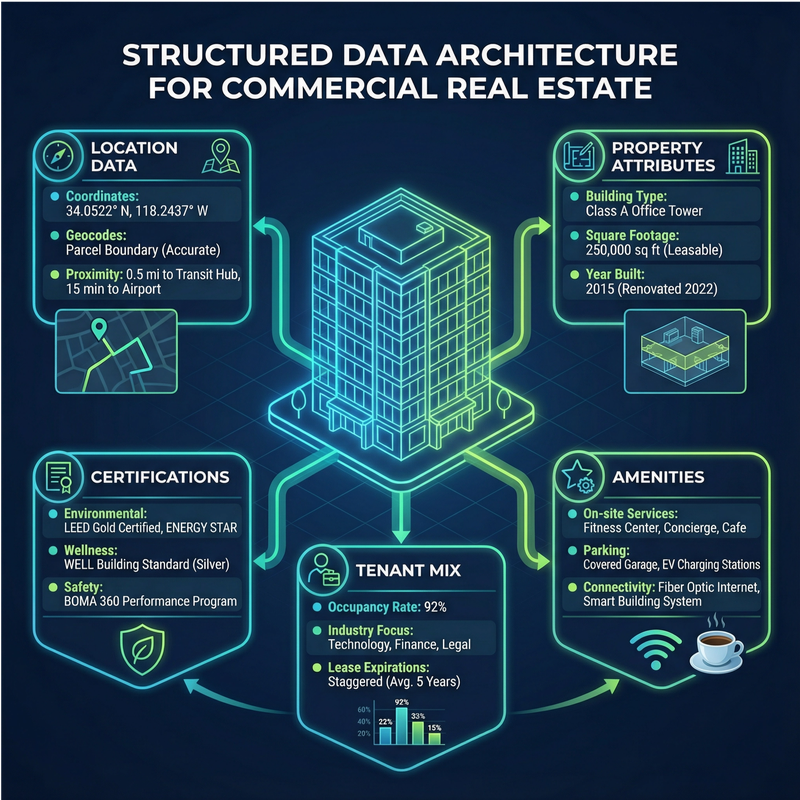
Here's what AI answer engines look for:
1. Structured Data and Schema Markup
AI reads structured data to understand what your content represents. For CRE, this means:
-
Property schema (address, square footage, type, amenities)
-
LocalBusiness schema (if applicable)
-
FAQPage schema for common questions
-
Review/rating schema for tenant testimonials
Example: Instead of "Located in the heart of downtown," structured data says: "address": "123 King Street West, Toronto, ON M5H 1A1" with latitude/longitude coordinates.
AI can map it. Compare it. Recommend it.
2. Semantic Content Modeling
AI understands entities and relationships, not just keywords.
Instead of keyword-stuffing "Toronto office space" 47 times, model your content with clear entities:
-
Building entity: First Canadian Place
-
Property type: Class AAA office tower
-
Location entity: Toronto Financial District
-
Amenities entities: Underground parking, PATH network access, LEED Gold
-
Tenant entity types: Financial services, law firms, consulting
AI systems can connect these entities to user queries in ways traditional SEO never could.
3. Clear, Factual Answers to Common Questions
AI answer engines pull direct answers from content. If someone asks "Does [building] have EV charging?" your page should have a clear, extractable answer:
✅ Good (AI-readable): "First Canadian Place offers 50+ EV charging stations on levels P1 and P2, available to all tenants."
❌ Bad (AI-invisible): "We're committed to sustainable transportation options and have invested in the latest green technology for our parking facilities."
The second answer sounds good to humans. AI can't extract a yes/no answer.
4. Consistent NAP (Name, Address, Phone) Data
AI cross-references information. If your property address varies across your website, Google Business Profile, and third-party listings, AI can't confirm it's the same building.
Consistency = authority = visibility.
5. API-First Content Architecture
AI answer engines consume content via APIs, not by rendering web pages. If your CMS can't deliver structured JSON data about properties, you're invisibleThis is where headless CMS architecture becomes critical. Platforms like Agility CMS, Contentful, and Storyblok let you structure property data once and deliver it anywhere—websites, AI engines, mobile apps, kiosks.

Real-World Example: The Oxford Properties Difference
We've worked with Oxford Properties to transform their digital presence across 1,000+ property pages. Their headless Agility CMS implementation structures property data semantically:
-
Each property is a content entity with standardized fields
-
Amenities, certifications, and features are tagged consistently
-
Addresses, coordinates, and local context are machine-readable
-
Integration with Bynder DAM ensures image metadata is rich and structured
-
Elastic Search powers internal discovery; the same data feeds external AI engines
The result? Oxford properties now appear in AI-powered search results where competitors don't. When users ask about LEED-certified properties or transit-accessible office space, Oxford's structured data gets surfaced.
This isn't speculation. It's measurable. And it's a competitive advantage.
How to Start Optimizing for AI Discovery
You don't need to rebuild your entire digital ecosystem overnight. Start with high-value improvements:
Phase 1: Audit Your Content Structure (Week 1-2)
-
Review 5-10 top properties: Is key information clearly stated and structured?
-
Test AI queries: Ask ChatGPT or Perplexity about your properties by name. Do they surface accurate info?
-
Check schema markup: Use Google's Rich Results Test tool. Are you implementing RealEstateListing or LocalBusiness schema?
-
Evaluate NAP consistency across platforms
Phase 2: Implement Structured Data (Week 3-6)
-
Add schema markup to property pages (address, type, amenities, availability)
-
Create FAQ sections with clear, extractable answers
-
Standardize how you describe amenities, certifications, and features
-
Ensure images have descriptive alt text and metadata
Phase 3: Optimize Content for Queries (Week 7-10)
-
Identify top 20 questions prospects ask about your properties
-
Create content that directly answers these questions
-
Structure answers in Q&A format, bullet points, or clear paragraphs AI can extract
-
Test: Search for your own properties using natural language queries in AI engines
Phase 4: Consider Platform Modernization (Quarter 2+)
If your CMS is WordPress, Drupal, or an older monolithic system, you're fighting uphill. These platforms weren't built for structured content at scale.
Modern headless CMS platforms like Agility, Contentful, and Storyblok are API-first by design. They separate content (structured data) from presentation (websites), making it easy to:
-
Model properties as structured entities
-
Deliver content to AI engines via APIs
-
Maintain consistency across channels
-
Scale to hundreds of properties without technical debt
This is exactly what we did for Oxford Properties, Brookfield's First Canadian Place, and InterRent. The investment pays back quickly through improved discoverability and reduced content management overhead.
The Competitive Window is Narrow
Here's the reality: Most CRE portfolios are invisible to AI answer engines right now. That's a problem—but it's also an opportunity.
Early adopters of AEO will dominate AI-driven discovery for the next 12-18 months while competitors figure out what's happening. By the time AEO becomes standard practice, you'll have authority, data consistency, and market share.
But the window is narrow. AI adoption is accelerating faster than SEO did in the early 2000s. In 12 months, being "invisible to AI" will be as damaging as having no Google presence.
What This Means for Your Portfolio
If you manage 10+ properties and rely on digital channels for discovery, AEO isn't optional. It's the next evolution of how prospects find you.
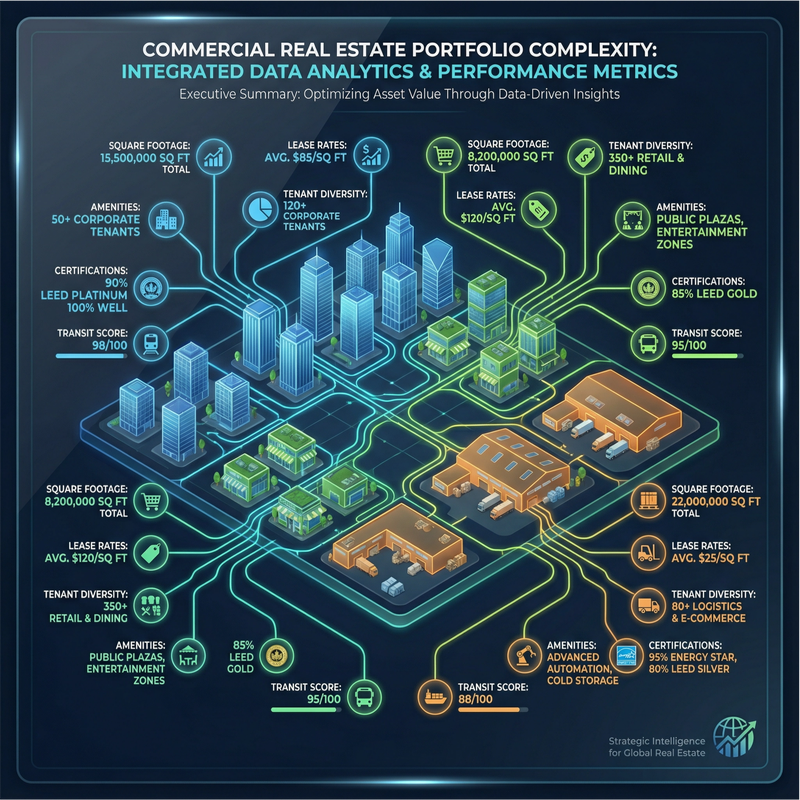
The business case is straightforward:
-
Increased visibility: Appear in AI-powered searches where competitors don't
-
Higher quality leads: Answer engines match properties to specific needs, not just keywords
-
Reduced CAC: Organic AI discovery costs nothing; paid ads keep getting more expensive
-
Future-proof: AI search is growing; traditional search is declining
Bottom line: AEO is the smart first step in maintaining competitive advantage as search behavior shifts.
Next Steps
Start with a simple test: Ask ChatGPT or Perplexity to recommend properties in your portfolio's market. Search for specific attributes your buildings offer. See what comes up.
If your properties aren't mentioned, you have work to do. If competitors appear instead, the urgency is even higher.
Want to understand where your portfolio stands? We've developed an AEO audit framework specifically for commercial real estate. It assesses your current content structure, identifies gaps, and prioritizes improvements based on ROI.
The key to winning in AI-driven discovery is structure. And structure starts with how you model and manage content—which is exactly what we've been doing for enterprises like Oxford Properties and Brookfield for 14+ years.
AI answer engines are here. The question isn't whether to optimize for them. It's whether you'll do it before your competitors.
About Dotfusion: We architect agentic content operations for enterprises modernizing from legacy platforms to AI-powered composable architectures. With 27 years of experience and deep expertise in headless CMS, UX design, and Answer Engine Optimization, we've helped commercial real estate leaders like Oxford Properties, Brookfield, and InterRent transform how they manage and deliver content at scale.