Updated November 6, 2026: Added the worked content-diagnosis example, a practical checklist, playable chapters and direct transcript access.
To prepare a website for AI search, find and repair the source content that cannot support a dependable answer. Look for conflicting facts, vague explanations and missing information. Then test the questions visitors actually ask and follow each answer back to its source pages.
In this episode of Beyond the CMS, Chris Bryce speaks with Megan Andrews, Head of Customer, U.S. at Squiz. Megan walks through Squiz Content Intelligence and explains how digital teams can move from an AI-readiness finding to a useful content decision.
This episode is for content, marketing and web leaders, particularly in higher education and government, who need to decide what to fix before introducing or improving conversational website search.
Watch the episode, listen on Transistor or read the transcript. Duration: 35:48.
What you will learn
- How topic-level checks can surface contradictory, ambiguous or missing information across a website.
- How to test real visitor questions and trace an answer back to the pages that informed it.
- Why an accessibility finding may need a content change, developer work or both.
- Where human research, team capacity and editorial judgment still matter when evaluating AI tools.
What Squiz Content Intelligence checks
In this discussion, content intelligence means examining the condition of website content and identifying what needs attention. Squiz Content Intelligence is the product Megan demonstrates: it brings accessibility auditing and AI-readiness analysis into the same content-health workflow.
Megan presents a demonstration environment that mirrors the audit interface, not a verified customer-results report. Watch the accessibility walkthrough at 21:05 and the AI-readiness walkthrough at 23:06.
Accessibility findings and remediation
The accessibility view shows issues, affected pages, current implementations and recommended fixes. It distinguishes changes a content team can make from work requiring developer involvement. Megan also describes remediation within Squiz's CMS where that integration supports it. This does not mean every issue can be automatically fixed across every CMS.
Topics, contradictions and missing context
The AI-readiness view groups related content into topics so the team can inspect problems across pages, rather than treating each page as an isolated document. Megan describes contradictions, ambiguous information and gaps that leave a question unanswered.
Squiz's documentation on topics describes the same categories: conflicting information, vague language and missing details. The useful output is not just a label saying content is ready. It is a finding a team can investigate and act on.
A worked example: conflicting student-services phone numbers
At 24:04, Megan gives an illustrative example: one area of a university website lists a student-services phone number, while another lists a different number after the service has moved. She uses it to explain the kind of contradiction the tool can flag; it is not a documented customer incident or a measured result.
The problem is not simply that a page is old. Two pages now offer competing facts about the same service. A person asking how to contact student services needs a dependable number, and a generated answer needs a trustworthy source from which to draw it.
A practical response is to confirm the correct contact details with the service owner, update the conflicting pages and test the contact question again. If the answer still cites an outdated page, follow that source and investigate what remains unresolved. Those actions are an editorial application of the discussion, not a claim that the product automatically decides which phone number is authoritative.
The same distinction applies to ambiguity and missing information: a tool can identify a problem, but the responsible team still needs to supply the facts and context that resolve it.
From finding to action: a content-diagnosis checklist
Use this checklist as an editorial synthesis of the walkthrough, not as a guaranteed ranking method or a replacement for accessibility testing.
- Contradictory information: Find the competing source pages, confirm the authoritative fact with the content owner and align the published information.
- Ambiguous information: Identify what a reader cannot tell from the page and add the context needed to understand the answer.
- Missing information: Check whether an important visitor question has a useful answer anywhere on the site before creating or updating content.
- An accessibility issue: Review the specific finding and assign the work to an editor or developer according to the implementation involved.
- An unsatisfactory generated answer: Inspect its cited source pages, repair the underlying information and retest with human judgment.
Test real questions, then inspect the source pages
Megan cautions against assuming a team must read every generated question and response. A more useful starting point is the questions people already ask: site-search queries and the recurring questions heard by advisors or other front-line staff.
At 30:01, she explains this question-led approach. Ask the tool an important question, inspect its proposed answer and check whether it is accurate and specific enough. At 30:40, she describes tracing the response to its source pages. That makes a weak answer a starting point for investigation rather than a prompt to keep rewriting the question.
Keep the loop simple: collect real questions, inspect answers, follow sources, repair the information and retest. The phone-number example makes the ownership requirement clear: an answer is not fixed until the team has resolved the competing facts behind it.
Content strategy still matters behind the interface
Visitors do not always know which department owns an answer or which navigation label to choose. Conversational search lets them begin with a question, but the answer still needs content with enough context to make sense outside its original page.
Megan shows conversational search on Squiz's site and discusses a University of Montana example combining a chat-style answer with conventional results. This is not necessarily a choice between an entirely new interface and familiar website navigation. The interface should serve the visitor's task.
Human research and judgment
Megan describes a student focus group in which some participants initially resisted AI, then responded more positively when an interface helped with a concrete website problem. That is an anecdote from the conversation, not a general finding about all students.
Chris and Megan also discuss synthetic personas. Simulated users may help with exploration, but can miss real attitudes and blind spots. Human involvement remains important both in research and in reviewing the answers a system produces.
Platform choice and team capacity
The opening conversation contrasts an integrated digital experience platform with assembling a headless stack. Megan emphasizes capabilities designed to work together; Chris highlights the difficulty of explaining integration costs across multiple components.
The useful question is not which approach wins universally. It is how much architecture, integration and ongoing operation a team can support alongside the flexibility it needs. Include the people who will operate the platform after launch in that decision.
What the walkthrough does not establish
The demonstration explains a workflow; it does not prove a production customer's results. Accessibility compliance and AI visibility also require separate evaluation. Clear structure can help people and machines interpret content, but one form of testing does not establish the other.
Answer engine optimization (AEO) is work intended to make authoritative content easier for answer systems to find and use. Better source content does not guarantee inclusion or ranking in external AI answers. Megan's advice is to control the quality of the information an organization publishes, while recognizing what it cannot control about answer selection.
The closing discussion acknowledges difficulties with older content, time-sensitive information and contextual relevance. Work around news and safety alerts is described as evolving. The episode does not establish automatic retroactive internal linking or reliable breaking-news prioritization as complete product capabilities.
Chapters
- 0:00 Welcome to Beyond the CMS Episode 51
- 1:24 Megan Andrews and Squiz
- 2:30 DXP vs headless: team capacity and integration tradeoffs
- 5:57 Who Squiz serves: higher education and government
- 7:52 Thoughtful AI and humans in the loop
- 11:23 What students actually want from AI search
- 12:45 Synthetic personas and real-user blind spots
- 15:31 Conversational website interfaces
- 17:10 Squiz conversational search demo
- 18:30 Why AI makes content strategy more important
- 21:05 Content Intelligence accessibility walkthrough
- 23:06 AI readiness: contradictions, ambiguity and gaps
- 25:21 University of Montana search example
- 26:50 SEO vs AEO: control what you can control
- 28:53 Test real questions and trace the source pages
- 30:57 Related content, freshness and unresolved limits
- 34:21 Connect with Megan and closing thoughts
Frequently asked questions
What is Squiz Content Intelligence?
A tool for auditing website accessibility and AI readiness. In the walkthrough, Megan shows topic-level findings, suggested fixes and issues such as contradictory, ambiguous or missing information.
Does conversational search replace website navigation?
Not necessarily. Megan shows how a conversational interface can sit alongside conventional search results and existing navigation.
Where should a team start with AI-search readiness?
Start with the questions users actually ask. Test the answers, follow their source pages and repair missing, unclear or conflicting information.
Can better content guarantee visibility in AI answers?
No. Megan recommends controlling the quality of your own source content while recognizing that external answer-engine selection remains uncertain.
About Megan Andrews and this episode
Megan Andrews is Head of Customer, U.S. at Squiz. She oversees client expansion, renewals and customer growth strategy, with a background in enterprise technology, SaaS and digital transformation. Connect with Megan on LinkedIn or explore Squiz.
Beyond the CMS is hosted by Chris Bryce, founder of Dotfusion.
Watch, listen and read
- Watch Episode 51 on YouTube
- Listen to Episode 51 on Transistor
- Read the full Episode 51 transcript
- Follow Beyond the CMS on Apple Podcasts or Spotify.
Related episodes and your next step
- Episode 50 with Olivier Dobberkau: search, semantic retrieval and RAG. Start here for the architecture behind the diagnostic work discussed in Episode 51.
- Episode 48 with Joyce Peralta: content modeling and governance in higher education. Explore the organizational work behind keeping content useful across a complex institution.
- Episode 46 with Joel Goodman of Squiz: AI-ready content. Continue into query fanout and the questions content needs to answer.
If these checks expose a deeper problem with content ownership, reusable content structures or the platform your team operates, explore Dotfusion's headless CMS and content-platform services. The next step should follow the problem: fix the content and operating model first, and assess modernization when the platform itself is in the way.
Related Episodes
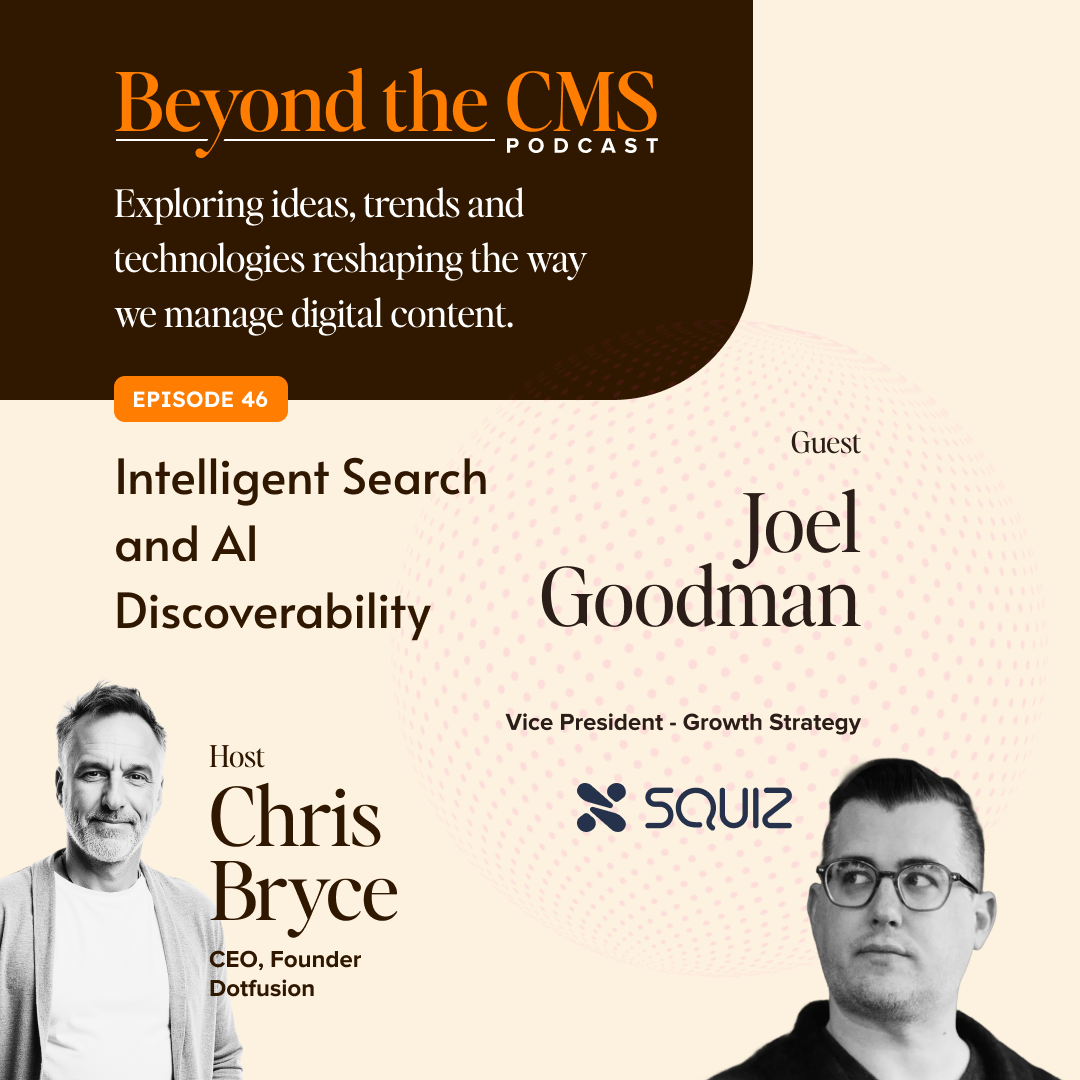
Beyond The CMS #46 - Is Your Content AI-Ready? - Joel Goodman (Squiz)
Joel Goodman of Squiz joins Chris Bryce to unpack query fanout, content intelligence, and what it takes to make enterprise content AI-ready before you migrate.
View Full Episode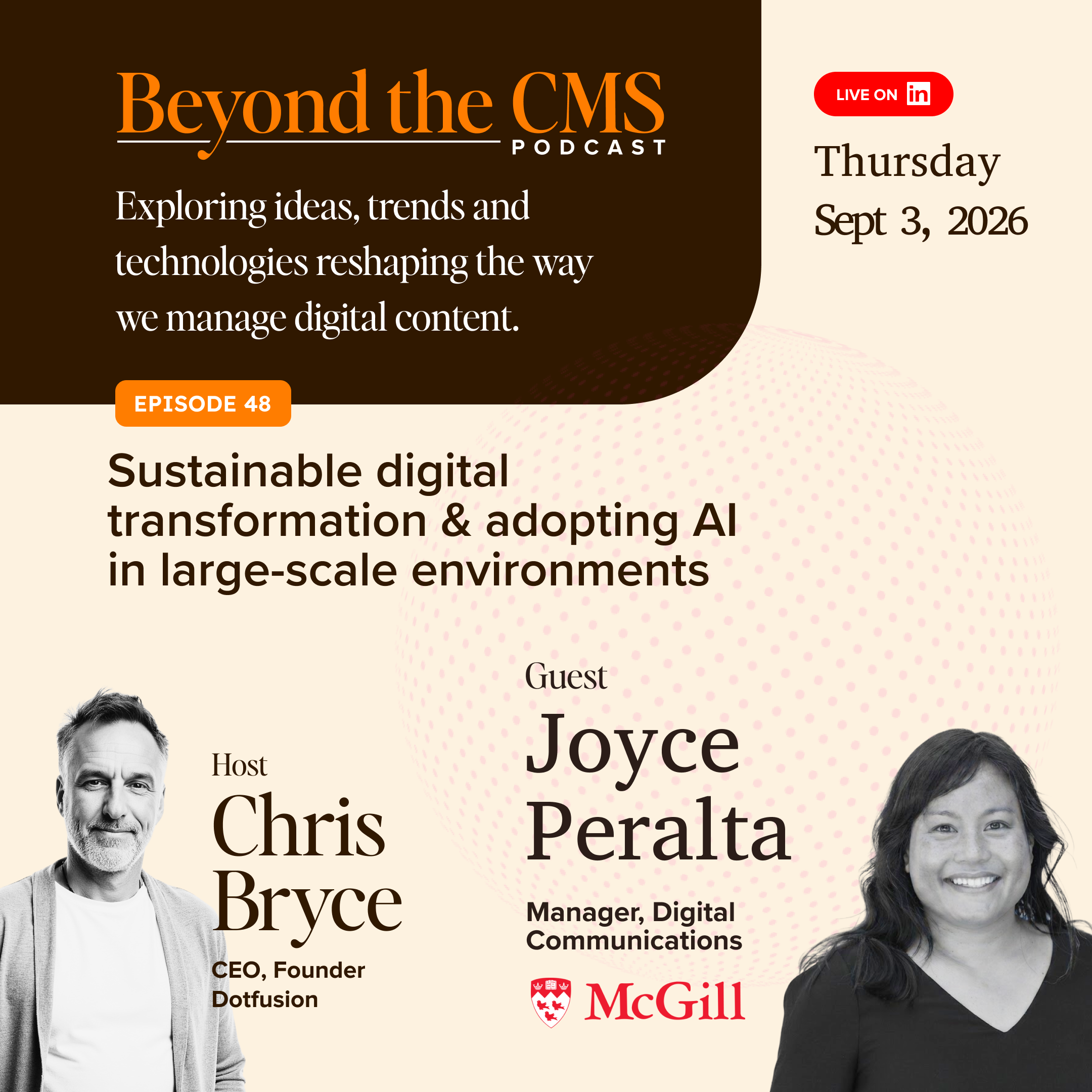
Beyond The CMS #48 - How McGill Uses AI and Unified Teams to Manage Digital Transformation - Joyce Peralta (McGill University)
Joyce Peralta of McGill University joins Chris Bryce to unpack why AI amplifies content inconsistency instead of causing it, and how a federated content model can fix it.
View Full Episode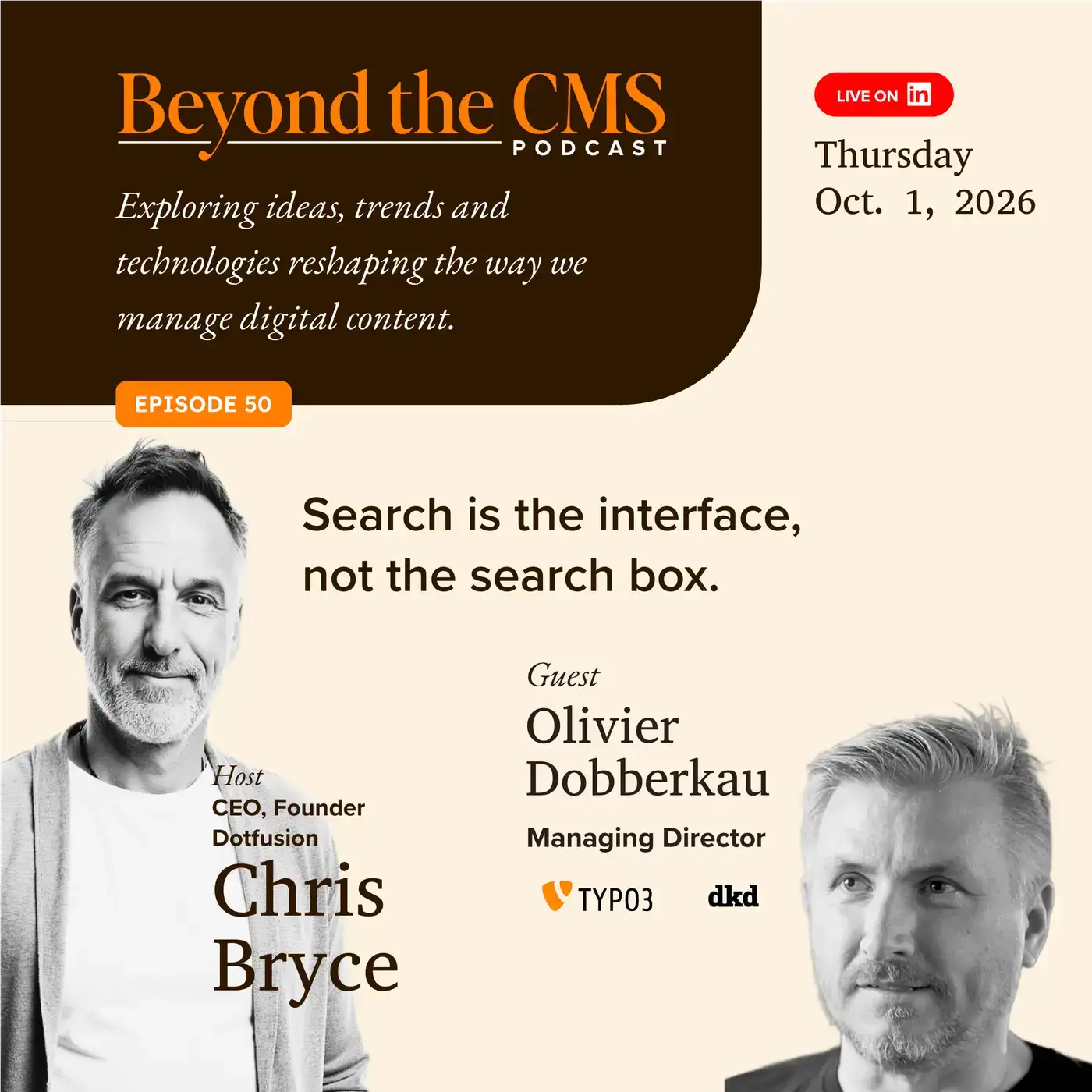
Search Is the Interface: Semantic Search and RAG - Olivier Dobberkau (dkd / TYPO3)
Olivier Dobberkau explains how enterprise search is evolving from keywords to semantic search and RAG, and why better content must come first.
View Full Episode