— Answer Engine Optimization
Part 3 - Google's Universal Commerce Protocol: SEO, AEO, and the Future of Discovery Commerce
In Part 1, we covered the business case for Universal Commerce Protocol (UCP). In Part 2, we examined the technical architecture and integration requirements. Now we address the question that keeps CMOs awake: How do customers find your products when AI agents become the curators?
This is where traditional SEO meets Answer Engine Optimization (AEO), and where commerce marketing strategy needs fundamental rethinking.
Quick Navigation
- The Discovery Shift: From Search to Conversation
- Traditional SEO Still Matters (But Differently)
- Answer Engine Optimization (AEO): The New Discipline
- The New Paid Media Landscape: Ads in AI Experiences
- Rethinking Demand Generation Strategy
- SEO vs. AEO: A Framework for CMOs
- Measuring Success in Agentic Commerce
- The Long Game: Building for an AI-First Commerce World
- Practical Next Steps for Marketing Leaders
- Final Thoughts
The Discovery Shift: From Search to Conversation
For 25 years, eCommerce growth depended on three discovery channels:
- Organic search (Google, Bing)
- Paid search (Google Ads, Shopping campaigns)
- Marketplaces (Amazon, eBay, Walmart.com)
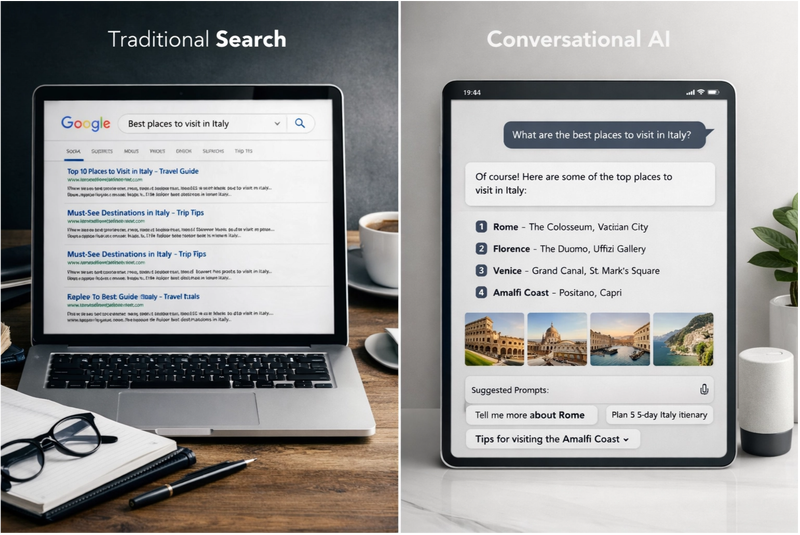
Universal Commerce Protocol introduces a fourth: AI-mediated discovery, where conversational agents act as personal shopping assistants, curating products based on natural language queries.
The user journey changes:
Traditional eCommerce: User searches "comfortable floral leggings" → Clicks product listing → Lands on PDP → Adds to cart → Goes to checkout → Completes purchase
Agentic Commerce: User asks Gemini "I need comfortable leggings with a floral print for working out" → Gemini surfaces 3-5 curated options with images, reviews, prices → User selects → Purchase completes in-conversation
The product detail page (PDP) and traditional checkout flow can disappear entirely. Your product gets surfaced—or it doesn't—based on how well your data aligns with the AI's understanding of the query.
Traditional SEO Still Matters (But Differently)
Some marketers assume AI search makes traditional SEO obsolete. That's wrong.
Google's AI Mode and Gemini still pull product data from the same sources that power traditional search:
- Google Merchant Center (product feeds)
- Indexed web pages (product detail pages with structured data)
- Google Shopping listings
- Business profiles and reviews
If your product isn't indexed and structured for Google Search, it won't surface in AI Mode either.
Traditional SEO hygiene remains foundational:
- Technical SEO: Fast site performance, mobile optimization, proper indexing
- Structured data: Schema.org markup for Product, Offer, AggregateRating, Availability
- Image optimization: High-quality images with descriptive alt text and filenames
- Content quality: Detailed product descriptions with semantic richness
However, the way these signals are used changes significantly.
Answer Engine Optimization (AEO): The New Discipline

AEO extends SEO for AI-native experiences. Instead of optimizing for 10 blue links, you're optimizing for conversational responses where your product gets recommended in context.
1. Semantic Product Attributes
Traditional SEO optimized for keywords: "women's athletic leggings size medium black."
AEO optimizes for attributes and context: What problem does the product solve? What's the use case? What are the qualitative characteristics?
Example: Running Shoes
Traditional product title: "Nike Air Zoom Pegasus 40 Men's Running Shoes - Blue/White - Size 10"
AEO-optimized product data:
- Title: Nike Air Zoom Pegasus 40 Men's Running Shoes
- Color: Blue/White
- Size: 10
- Use case: Road running, daily training
- Key features: Responsive cushioning, breathable mesh upper, durable rubber outsole
- Suitable for: Neutral runners, moderate to high mileage
- Terrain: Paved roads, treadmill
- Distance: 5K to marathon
- Foot strike: Neutral
- Arch support: Medium
When a user asks Gemini, "I need running shoes for training for a half marathon on roads," the agent needs structured attributes to determine if your product matches. Keyword matching isn't enough; semantic understanding is.
2. Conversational Query Mapping
Traditional keyword research identified high-volume search terms. AEO requires understanding how users ask for products in natural language.
Traditional queries:
- "best wireless headphones"
- "Sony WH-1000XM5 price"
- "noise cancelling headphones review"
Conversational AEO queries:
- "I need headphones for my commute that block out subway noise"
- "What's a good pair of over-ear headphones under $300 with long battery life?"
- "My current headphones hurt after wearing them for a few hours—what are more comfortable options?"
Your product feed needs to map to intent and context, not just keywords. This requires:
- Problem-solution mapping: What customer problem does your product solve?
- Constraint handling: Price range, delivery speed, brand preference, feature requirements
- Comparative attributes: Better than what? Faster, cheaper, more durable?
3. Product Feed Enrichment for AI Discoverability
Standard product feeds (Google Merchant Center format) include:
- ID, title, description, link, image_link, price, availability, brand, GTIN, MPN
AEO-ready product feeds add:
- Detailed attributes: Material, dimensions, weight, care instructions, warranty
- Use case tags: "indoor," "outdoor," "travel," "professional," "casual"
- Customer segment fit: "beginner," "advanced," "budget-conscious," "premium"
- Compatibility data: Works with what devices, platforms, or accessories?
- Sustainability/values: B-Corp certified, carbon-neutral shipping, ethical sourcing
- Rich media: 360° images, video demonstrations, lifestyle photography
Platforms like Feedonomics (part of Commerce/BigCommerce) specialize in optimizing product feeds for AI discoverability by enriching titles, attributes, and taxonomy.
If you're running your own product feed management, you'll need to:
- Expand attribute coverage (don't rely on minimal required fields)
- Use natural language in descriptions (conversational, not keyword-stuffed)
- Add structured JSON-LD schema to product pages
- Include qualitative attributes (comfort, durability, aesthetics) not just specs
4. Reviews and Social Proof in AI Recommendations
AI agents heavily weight customer reviews when curating recommendations. Products with higher ratings and more reviews get preferential treatment in conversational results.
Best practices:
- Aggregate reviews across sources: Sync reviews from your site, Google, Trustpilot, and other platforms
- Encourage detailed reviews: AI agents parse sentiment and specifics ("comfortable," "runs small," "battery lasts 2 days")
- Respond to reviews: Demonstrates active customer engagement, which signals quality
- Highlight verified purchases: Increases trust signals for AI curation
Traditional SEO valued review quantity and star ratings for rich snippets. AEO values review content—what customers say about specific attributes.
5. Brand Visibility in AI Responses
In traditional search, brand awareness helped with click-through rates. In agentic commerce, brand awareness influences whether the AI agent recommends your product at all.
When a user asks for "high-quality wireless earbuds," Gemini is more likely to surface Apple, Sony, or Bose because those brands have strong semantic associations with quality in that category.
Emerging or D2C brands need to build semantic authority:
- Thought leadership content: Publish guides, comparisons, and educational content that get indexed
- PR and media mentions: Coverage in reputable publications builds brand-entity recognition in Google's Knowledge Graph
- Influencer and expert endorsements: Reviews from recognized figures create associative authority
- Category expertise: Establish your brand as the brand for a specific niche (sustainable activewear, minimalist travel gear, etc.)
This is reputation engineering for AI comprehension.
The New Paid Media Landscape: Ads in AI Experiences

Google is testing ad formats inside AI Mode. Direct Offers allow advertisers to present exclusive deals ("Sponsored deal") within conversational product listings.
This creates a new performance marketing channel:
Traditional Google Shopping Ads:
- Appear in Shopping tab and search results
- Bid on keywords and product categories
- Drive traffic to product pages
- Measure conversions on-site
AI Mode Direct Offers:
- Appear inline with AI-curated product recommendations
- Targeting based on conversational context (not just keywords)
- Purchase happens in-conversation
- Measure conversions in AI environment
Implications for Performance Marketers:
- Bidding strategies evolve: You're bidding on conversational intents, not keywords. "Help me find affordable workout gear" is a broader, higher-intent signal than "women's leggings."
- Creative testing changes: Product titles, images, and promotional messaging need to work in conversational contexts, not grid layouts.
- Attribution breaks (again): Conversions happen in Gemini or AI Mode, not your website. You'll need new tracking infrastructure—likely through Google's Merchant Center reporting.
- CAC may decrease: If AI-driven recommendations have lower abandonment rates than traditional eCommerce funnels, your customer acquisition costs could drop significantly. Or, competition drives up the cost of "Sponsored deals." Time will tell.
Rethinking Demand Generation Strategy

For CMOs, UCP and agentic commerce require rethinking several pillars of demand generation:
1. Content Marketing Shifts to AI Training
Your blog posts, buying guides, and product comparison content have a new purpose: training AI agents to understand your category and recommend your products.
When Gemini answers "What are the best standing desks for home offices?", it synthesizes information from:
- Product pages with structured data
- Editorial reviews and buying guides
- User-generated content (reviews, forums)
- Brand-published content (blogs, videos, comparison tools)
If your content is comprehensive, structured, and authoritative, AI agents cite it—and recommend your products.
Actionable strategy:
- Publish category-defining content ("The Complete Guide to Ergonomic Office Furniture")
- Use structured headers, lists, and comparison tables (easily parsed by AI)
- Include schema markup (HowTo, FAQPage, Comparison)
- Link to product pages with clear semantic relationships
2. Influencer and Creator Content Becomes AI Context
AI agents don't just read your owned content—they process the entire indexed web, including influencer reviews, YouTube videos, TikTok posts (increasingly indexed), and Reddit discussions.
A positive review from a trusted creator in your category can influence whether an AI agent recommends your product.
Emerging best practice:
- Partner with creators who publish searchable, indexable content (YouTube, blogs, podcasts)
- Ensure product placements include detailed descriptions and semantic attributes
- Optimize creator content for search (titles, descriptions, timestamps, transcripts)
3. Marketplace Strategy Gets More Complex
Selling on Amazon has been the default D2C fallback. But if consumers can purchase directly from your brand through Gemini, do you still need Amazon?
The calculation changes:
- Amazon pros: Massive traffic, trust, fulfillment infrastructure
- Amazon cons: High fees (15-45%), loss of customer data, commoditization
With UCP, brands can reach consumers in AI-native discovery without Amazon as an intermediary—if they have strong product data, reviews, and brand recognition.
Expect D2C brands to reevaluate marketplace dependency. However, Amazon isn't going away; it will integrate agentic commerce too (potentially through its own Alexa-driven protocol).
4. Customer Lifetime Value (LTV) Becomes Critical
When customers purchase through an AI agent, you may lose direct relationship touchpoints. If Gemini handles post-purchase support, order tracking, and reordering, do customers even remember your brand?
The strategic response:
- Build direct relationships (email, SMS, loyalty programs) after the first UCP purchase
- Offer member-exclusive benefits that require account creation
- Use post-purchase engagement (unboxing experiences, educational content) to build brand recall
Owning the customer relationship matters more in agentic commerce, not less.
SEO vs. AEO: A Framework for CMOs
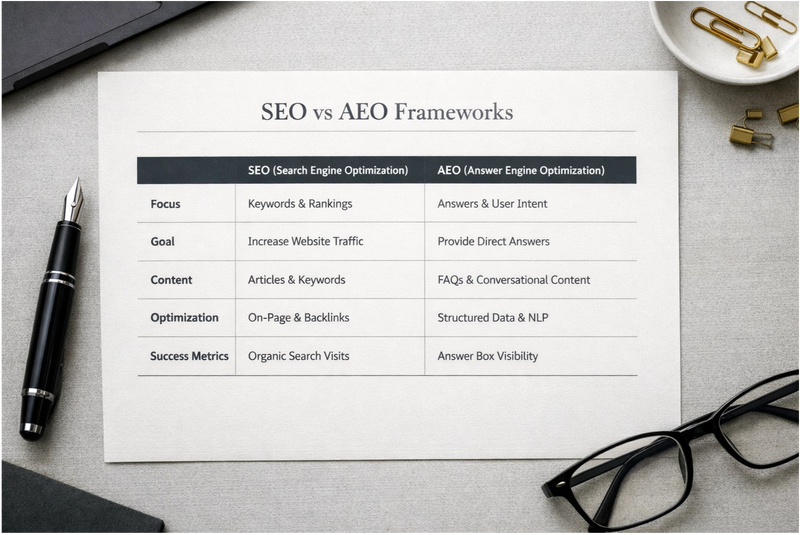
Traditional SEO and AEO aren't separate—they're layered.
| Tactic | Traditional SEO | AEO |
|---|---|---|
| Keyword research | High-volume search terms | Conversational intents |
| Content optimization | Keyword density, headers | Semantic structure, natural language |
| Product data | Basic attributes | Rich, context-aware attributes |
| Links | Backlink authority | Entity relationships, Knowledge Graph |
| User signals | Click-through rate, bounce rate | Recommendation acceptance, transaction completion |
| Paid strategy | Keyword bidding | Contextual intent bidding |
| Measurement | Rankings, traffic, conversions | AI surface visibility, recommendation rate |
CMOs need to invest in both. Traditional SEO ensures your products are indexed and structured. AEO ensures they're recommended in conversational contexts.
Measuring Success in Agentic Commerce
Your analytics stack needs new metrics:
Traditional Metrics (Still Important):
- Organic traffic
- Conversion rate
- Average order value (AOV)
- Customer acquisition cost (CAC)
New AEO Metrics:
- AI surface impressions: How often your products appear in AI Mode / Gemini recommendations
- Recommendation acceptance rate: What % of surfaced products get purchased?
- Conversational funnel drop-off: Where do users abandon in the AI-driven flow?
- Multi-session attribution: Did the user discover in AI Mode but purchase on your website later?
Google will likely expose these metrics through Merchant Center reporting, similar to how Shopping campaigns report today. Early adopters should work with their analytics teams to define these KPIs now.
The Long Game: Building for an AI-First Commerce World

UCP is the beginning, not the end. Over the next 3-5 years, expect:
- More AI surfaces: ChatGPT (via ACP), Microsoft Copilot, Perplexity, Meta AI, Apple Intelligence
- Voice commerce comeback: Conversational commerce works with voice when combined with visual context (smart displays, AR glasses)
- Category expansion: Agentic commerce will move beyond consumer retail into B2B procurement, travel booking, financial services
- Agent-to-agent commerce: AI agents purchasing on behalf of businesses (automated supply chain replenishment)
CMOs who build for AI discoverability now—structured data, rich product feeds, conversational content, brand authority—will compound advantage as agentic commerce scales.
Those who wait for "proof" will find themselves locked out of a discovery channel where consumer behavior has already shifted.
Practical Next Steps for Marketing Leaders
- Audit product feed quality. How complete are your attributes? Are descriptions conversational and semantic? Do you have rich media?
- Implement comprehensive schema markup. Product, Offer, AggregateRating, FAQPage, HowTo—cover all relevant schema types.
- Optimize for conversational queries. Research how users ask for your products in natural language. Update content and product data accordingly.
- Build category authority. Publish educational content that trains AI agents to understand your space and recommend your brand.
- Monitor AI search visibility. Use tools (emerging AEO platforms) to track how often your products surface in AI recommendations.
- Test Direct Offers in AI Mode. When available, experiment with paid placements in conversational commerce.
- Prepare attribution infrastructure. Work with your analytics team to track conversions that happen outside your website.
Final Thoughts
Universal Commerce Protocol isn't just a technical integration—it's a market structure shift. The companies that thrive will treat agentic commerce as a first-class channel, not an experimental side project.
Traditional SEO assumed users would visit your website. AEO assumes they won't—the AI agent handles discovery, comparison, and transaction.
Your job as a CMO is to ensure your products get recommended when those conversations happen.
The era of destination-based eCommerce is ending. Ambient commerce—buying wherever you are, through whatever interface you're using—is here.
Your platform, your data, and your marketing strategy need to be ready.