— Enterprise Guide
Composable Architecture: A Practical Guide for Enterprise Decision-Makers
Most writing about composable architecture is produced by companies that profit from composable adoption. That framing shapes everything: the definition, the benefits, the case studies, and most importantly, what gets left out.
This page is written by practitioners who have been building headless and composable web platforms for enterprise organizations since before the word "composable" entered the industry's vocabulary. We'll cover what composable architecture actually is, what the current data shows about adoption and outcomes, when it's the right choice, and, just as important, when it genuinely isn't.
📑 Table of Contents
- What is composable architecture?
- MACH architecture: the four principles explained
- Composable vs. monolithic: what actually changes
- The business case: what adoption data shows
- When composable architecture is the right choice
- When composable architecture is not the right choice
- How composable architecture supports AI discoverability
- How Dotfusion approaches composable architecture
- Composable in practice: client examples
- How to evaluate an implementation partner
- Frequently Asked Questions
What is composable architecture?

Composable architecture is an approach to building enterprise digital platforms from independent, modular components rather than as a single integrated system. Each component does one thing well, connects to the others through standard APIs, and can be updated, replaced, or scaled without disrupting the rest of the stack.
In a composable system, your content management platform, commerce engine, search tool, personalization layer, and analytics stack are separate services working together. You choose the best tool for each job rather than accepting whatever comes bundled in a single vendor's platform. When one component needs to change, only that component changes.
A note on disambiguation: "Composable architecture" in the enterprise digital context is entirely separate from The Composable Architecture (TCA), which is a Swift/iOS application design pattern used in mobile development. If you arrived here looking for the Swift framework, Point-Free's TCA documentation is what you need. Everything that follows is about enterprise web and content platforms.
Composable architecture for enterprise digital platforms emerged from a broader shift in software engineering toward modularity, cloud-native services, and API-driven integration. In the content and digital experience space, it's formalized through the MACH framework, the closest thing the industry has to a shared specification for what "composable" means in practice.
MACH architecture: the four principles explained

MACH is the acronym that defines a composable approach to enterprise technology. It stands for:
- M (Microservices): Individual business capabilities are packaged as independent services that communicate through APIs. Each service can be deployed, updated, and scaled on its own without touching the others.
- A (API-first): Every service exposes a documented API as its primary interface. Integration is planned and explicit, not improvised around proprietary connectors.
- C (Cloud-native): Services are designed to run in cloud environments (AWS, Azure, GCP) with elastic scaling, managed infrastructure, and geographic distribution built in.
- H (Headless): The content repository is decoupled from the presentation layer. Content is stored once in a structured format and delivered through APIs to any channel: website, mobile app, digital display, voice interface, partner portal.
The MACH Alliance, an industry body formed in June 2020, has grown to over 100 member organizations. Its annual research (conducted among enterprise IT decision-makers at director level and above, at companies with 5,000+ employees and $500M+ in revenue) represents the most rigorous available data on composable adoption and business outcomes.
Composable vs. monolithic: what actually changes

A monolithic platform bundles everything in one package. Your CMS, commerce engine, search, personalization, and presentation layer are tightly coupled inside a single system. That coupling creates simplicity in straightforward use cases and brittleness in complex ones.
The practical consequences are predictable:
- Upgrading one part of the system requires testing the entire system
- Frontend developers are constrained by what the CMS can output
- Adding a new channel (a mobile app, a digital display network, a partner portal) requires either replicating content or rebuilding the publishing workflow
- Vendor lock-in concentrates risk: when the vendor's roadmap diverges from your needs, you're stuck with an expensive migration or an outdated platform
According to the MACH Alliance 2025 Global Research, organizations with mostly legacy monolithic infrastructure spend approximately 60% of their IT time and budget on maintenance and upgrades, leaving limited capacity for new initiatives.
Composable architecture addresses this by loosening the coupling. Components integrate through APIs; changes are scoped to individual services; teams can work in parallel. The tradeoff (and there is a real one) is that this approach introduces different complexity. Managing five vendor relationships and their API integrations is genuinely harder than managing one.
The business case: what adoption data shows

The most comprehensive data comes from the MACH Alliance 2025 Global Annual Research, a survey of 561 enterprise IT decision-makers:
- 87% of enterprises have widely implemented MACH technologies across their organizations
- 93% of adopters report that their MACH investment met or exceeded ROI expectations, a 7% increase from the prior year
- Organizations project that 61% of their technology stack will be MACH or composable by the start of 2026
- The top three reported benefits: improved customer experience (55%), greater automation through systems integration (54%), and increased organizational agility (50%)
Gartner's 2025 Digital Experience Platform Magic Quadrant added composable architecture as a mandatory evaluation criterion for the first time. Gartner projects that by 2026, at least 70% of enterprises will be mandated to adopt composable DXP technology, up from 50% in 2023.
Storyblok's State of CMS 2025 found that 69% of headless CMS adopters reported improved time-to-market and productivity. 41% reported a measurable ROI increase.
One finding worth noting: 77% of MACH-mature organizations are actively using AI, compared to 36% of organizations early in their MACH journey. Composable architecture and AI capability aren't parallel tracks. The same infrastructure that enables composability tends to enable AI integration.
When composable architecture is the right choice
High content velocity requirements. If your team publishes content across multiple channels, manages real-time data (property listings, inventory, pricing), or needs to push updates without developer involvement, a composable system with a headless CMS at the center handles this cleanly.
Multi-brand or multi-region operations. When a single organization manages distinct brands, markets, or regions (each with its own editorial teams, governance requirements, and performance standards), composable architecture lets you share infrastructure while keeping content operations independent per entity.
Technical catalog or data-driven content. Organizations managing complex product catalogs, property databases, or technical documentation benefit from a composable approach because structured, API-delivered content integrates directly with upstream data systems without requiring manual republication every time source data changes.
Long-term platform independence. If your organization has been burned by vendor lock-in before, composable architecture's modular structure reduces the risk of any single vendor's pricing or roadmap changes derailing your operations.
Established DevOps and integration capability. Composable architecture performs best in organizations that already have the internal or agency capability to manage API integrations, operate cloud infrastructure, and govern a multi-vendor technology stack.
When composable architecture is not the right choice

This is the section you won't find on most vendor blogs. It's also the section that enterprise buyers doing real due diligence need most.
Small teams without integration capability. A composable stack requires the capacity to select, integrate, and maintain multiple vendor relationships. If your team is two or three people, the operational overhead is likely to outweigh the benefits.
Simple sites with stable requirements. If your digital presence is a corporate website with a manageable number of pages, predictable content, and no multi-channel requirements, composable architecture introduces engineering complexity without a corresponding return.
Organizations without DevOps maturity. MACH architecture is cloud-native by design. If your IT organization doesn't have experience managing containerized services, cloud environments, or API governance, the transition creates new operational risks.
Projects with compressed timelines and limited platform budgets. Composable implementations take longer to scope and configure than deploying a monolithic CMS out of the box. If you have a three-month runway and a tight budget, a phased approach (starting with a modern headless CMS) is often the more honest recommendation.
Being direct about this is part of how Dotfusion operates. A platform-agnostic recommendation sometimes means telling a client that the architecture they're considering is more than their current situation warrants.
How composable architecture supports AI discoverability
The structural properties that make composable platforms good for content operations are the same properties that make content discoverable by AI answer engines.
AI systems (ChatGPT, Perplexity, Google's AI Overviews) source content from structured, machine-readable web pages. When your content is managed in a headless CMS with explicit content models, delivered through APIs as clean semantic HTML, and enriched with schema markup, it's precisely the format these systems can parse and cite.
Gartner projects that by 2027, 40% of organizations will fail to deliver meaningful digital customer experiences due to a lack of AI-driven content coordination and content operations strategy. Composable architecture's structured content supply chain is a direct response to this gap.
When structured content is created once, stored in a headless CMS, and delivered through APIs to multiple channels, the foundation supports the Answer Engine Optimization (AEO) practices that determine whether your content gets cited by AI research tools. Read more on AEO as an enterprise content strategy.
How Dotfusion approaches composable architecture

Dotfusion has been building headless and composable digital platforms since 1998, before "composable" became an industry term. The approach is deliberately platform-agnostic. Our platform recommendations are based on each organization's technical requirements, content team structure, integration complexity, and growth trajectory.
The headless or composable CMS as the infrastructure hub. We work with Contentful, Storyblok, and Agility CMS, among others, and select based on fit.
Discoverability built into the build, not added after. AEO and SEO configuration isn't a post-launch conversation. Structured content models, schema markup, semantic HTML, and llms.txt setup are part of the build specifications from the start.
Content operations that scale after launch. A composable platform creates the capacity for content velocity. Realizing that capacity requires the workflows, governance structures, and, increasingly, agentic automation that let editorial teams produce and distribute content without proportionally increasing headcount. See what composable websites actually mean for content operations teams.
Composable in practice: client examples
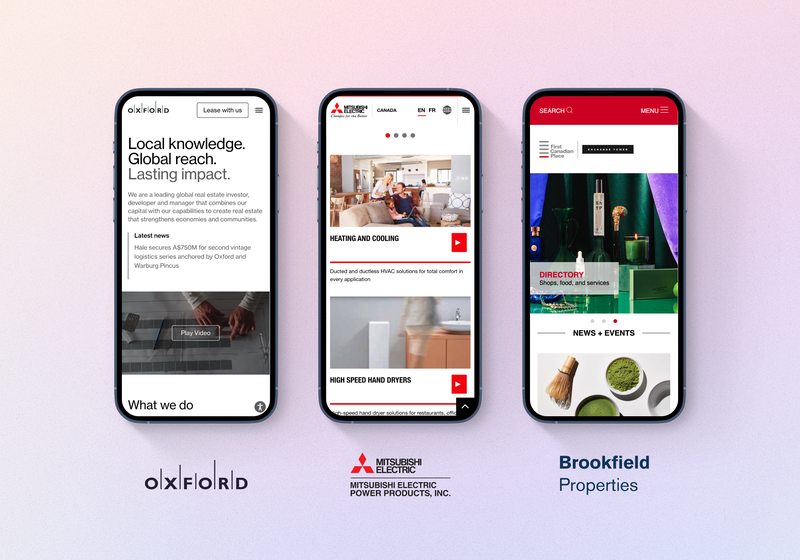
Oxford Properties manages one of the largest commercial real estate portfolios in North America. Hundreds of property pages needed to stay current with live property feeds, bilingual publishing requirements, and consistent brand standards. Dotfusion built their platform on Agility CMS with API-driven property data, Bynder DAM integration, and Elastic Search. Editorial teams publish across properties without developer involvement.
Mitsubishi Electric required a platform capable of handling complex technical product catalogs across multiple languages, with deep ERP integration to keep product data accurate without manual republication. The composable approach separated content management from data delivery: structured product content flows from upstream systems into the CMS and out to the website automatically.
Brookfield Properties / First Canadian Place replaced a legacy system that made routine content updates slow and developer-dependent: a structural problem, not a content problem.
In each case, the decision to adopt a composable approach came down to the same factors: content volume, multi-channel requirements, data integration complexity, and the need for editorial teams to operate independently of the development cycle.
How to evaluate a composable architecture implementation partner
Are their recommendations platform-agnostic? Partners with exclusive vendor relationships have commercial incentives that may not align with your requirements. Ask specifically: which platforms have you recommended against for certain clients, and why?
Do they have direct implementation experience? The right question isn't "are you certified with Contentful?" It's "what did your last Contentful composable implementation involve in terms of content modeling decisions, integration complexity, and migration risk?"
Are they honest about migration complexity? Legacy platform migrations from Sitecore, Adobe AEM, Drupal, or WordPress have consistent failure modes. A credible partner will surface these risks in the scoping phase. A useful self-assessment tool: the CMS migration checklist for enterprise teams.
Do they treat the headless CMS as the foundation? Ensure your implementation partner has genuine depth in headless CMS architecture as a starting point, not a supporting capability.
Frequently Asked Questions
What is composable architecture, in plain terms?
Composable architecture is an approach to building enterprise digital platforms from independent, modular components that connect through APIs. Instead of a single platform that handles everything, you select the best tool for each function (content management, commerce, search, personalization) and integrate them. When one component needs to change, only that component changes. The full stack remains intact.
What is the difference between composable architecture and headless CMS?
A headless CMS is one component within a composable architecture. It's the piece responsible for managing and delivering content through APIs. Composable architecture describes the full stack: the headless CMS sits alongside a composable commerce engine, API-first search, cloud-native hosting, and other modular services. You can adopt a headless CMS without building a full composable stack; you can't build a composable stack without something playing the headless CMS role.
Is composable architecture the same as MACH architecture?
They're closely related. MACH (Microservices, API-first, Cloud-native, Headless) is the specific implementation framework that most enterprise practitioners use when referring to composable architecture in the digital experience space. "Composable architecture" is the broader design principle; MACH is the specification.
How long does a composable architecture implementation take?
A greenfield composable CMS implementation for a mid-size enterprise typically takes four to six months from content modeling through launch. Migrations from platforms like AEM or Sitecore add time: typically six to twelve months for large portfolios. Content modeling decisions made quickly in scoping tend to generate technical debt that costs significantly more to fix post-launch.
Is composable architecture more expensive than a monolithic platform?
Initial implementation costs are typically higher. However, organizations with mostly legacy infrastructure spend approximately 60% of IT time and budget on system maintenance (MACH Alliance, 2025). Over a five-to-seven-year horizon, composable architecture's modular update model tends to produce a lower total cost than the major version upgrades required by monolithic platforms.
Can we migrate to composable architecture in phases rather than all at once?
Yes. For most large enterprises, a phased migration is the more practical path. A common starting point is adopting a headless CMS to replace only the content management layer, while keeping other systems in place. Additional composable components are introduced in subsequent phases. Read more on what CMOs need to know before going headless.
Does composable architecture require cloud hosting?
By design, yes. The "cloud-native" principle in MACH architecture assumes services run in cloud environments with elastic scaling. If your organization has data sovereignty requirements or on-premises mandates, the platform selection and architecture design need to account for these constraints from the beginning.
The architecture decision is the platform decision
Composable architecture is not a default upgrade from what you have. It's a deliberate decision with real prerequisites: technical capability, content strategy maturity, a multi-channel roadmap, and an implementation partner who understands both the platform and the content operations it needs to support after launch.
If you're evaluating composable architecture for your enterprise platform, talk to Dotfusion about your requirements. We'll tell you whether composable is the right answer for your situation, and if it is, how to build it in a way that performs.
Dotfusion is a certified B Corporation and enterprise digital agency specializing in headless and composable CMS development, Answer Engine Optimization, and AI-driven content operations. Official partners: Contentful, Storyblok, Agility CMS. Founded 1998, Toronto.
Further Reading
- Headless CMS vs. Traditional CMS: The ROI Guide
- The Future of Enterprise Web: Headless, Composable, and AI
- What CMOs Need to Know Before Going Headless
- Answer Engine Optimization: The Next Frontier in Digital Strategy
This post was conceived and written by Chris Bryce with our stack of AI research agents doing the heavy lifting on sources and data. If you want to talk about enterprise web strategy, AEO, or content operations, talk to us. We love this stuff.