— CMO Resource
Content Operations for Enterprise: The Complete 2026 Guide
Most enterprise marketing teams spend more time coordinating content than creating it. Six-week publishing lags, 340 versions of the same document, and content sitting in limbo aren't talent problems. They're content operations problems. This guide explains the systematic framework that Fortune 500 companies use to eliminate bottlenecks, accelerate time-to-market, and scale content production sustainably.
Updated October 6, 2026: corrected the source of the 77% AI workload statistic (Upwork Research Institute, not Deloitte).
Large organizations waste an average of $2.5 million annually on inefficient content processes. That's the real cost of missed deadlines, duplicated work, and content bottlenecks documented by Aprimo in 2026. The symptoms look familiar to any enterprise marketer: 340 Word documents named Homepage_v3_FINAL_Marko_edits_USE_THIS.docx, six-week lags between "content is ready" and "content is published," and four writers working on the same project with no shared structure.
This isn't a talent problem. It's a content operations problem.
Content operations (the systematic coordination of people, process, and technology across the content lifecycle) is the missing discipline between content strategy and execution. While 58% of marketers struggle to consistently create conversion-focused content according to the Content Marketing Institute, and 80% of enterprises are adopting headless or composable architectures, most organizations still manage content like it's 1995.
The gap between ambition and execution is widening. Marketing teams want to move faster. AI promises to accelerate production. Headless CMS platforms offer omnichannel flexibility. But without content operations discipline, organizations just produce chaos at a higher velocity. An Upwork Research Institute study found that 77% of employees who use AI say it has added to their workload, a productivity paradox driven by missing process frameworks.
This guide explains what content operations actually means for enterprises in 2026, why it matters more than your technology stack, and how to build a ContentOps framework that delivers measurable results. You'll learn the three-pillar model (people, process, technology), see real enterprise transformations, and get a practical roadmap you can implement in 90 days.
Whether you're a CMO frustrated by content bottlenecks, a marketing director drowning in coordination overhead, or a VP evaluating headless CMS platforms, content operations is the foundation that makes everything else work.
What is Content Operations? (And Why It Matters Now)
Defining Content Operations
Content operations is the discipline of coordinating people, processes, and technology to manage content at scale across its entire lifecycle. It's not just "content management" focused on storage and publishing. ContentOps covers everything from ideation and creation through distribution, measurement, and eventual archival or reuse.
Think of ContentOps as the operating system for your content. Strategy defines what you'll create and why. ContentOps defines how you'll actually execute that strategy efficiently, consistently, and at scale.
The framework bridges the chronic gap between ambitious content strategies and actual execution. Most enterprises excel at strategy documents but struggle with the systematic coordination needed to turn those plans into published content that drives business results.
Content Operations vs. Content Management vs. Content Marketing
These terms often get confused, but they represent different layers:
Content Management focuses on storage, organization, and publishing. Your CMS is a content management tool. It handles where content lives and how it gets onto your website or app. The IT or web team typically owns this layer.
Content Marketing focuses on strategy, creation, and audience engagement. It defines what content to create, for whom, and how to promote it. Marketing teams own this layer, measuring success through engagement, leads, and pipeline.
Content Operations sits between these layers, connecting strategy to execution. It's the process framework that coordinates how content moves from idea to published asset. ContentOps is inherently cross-functional: marketing and IT must collaborate for it to work.
The key distinction: content management is a technology concern, content marketing is a strategic concern, and content operations is a process concern. Most enterprises have invested in the first two while ignoring the third, which explains why content bottlenecks persist despite better tools and bigger teams.
Why Content Operations is Critical in 2026
Three converging trends make content operations essential right now:
First, content complexity has exploded. The average enterprise now manages content across websites, mobile apps, email campaigns, social platforms, sales enablement tools, customer portals, and increasingly, AI-powered answer engines. Creating content once and manually adapting it for each channel doesn't scale. You need systematic processes for omnichannel content delivery.
Second, AI is accelerating production without improving coordination. Tools like ChatGPT can generate drafts in seconds, but 77% of employees who use AI say it has added to their workload, according to the Upwork Research Institute. Why? Because generating content is the easy part. Coordinating what to create, who reviews it, how it gets approved, where it's published, and whether it's actually effective: that's the hard part. AI makes the coordination problem worse if you don't have solid ContentOps foundations.
Third, Gartner warns that by 2027, 40% of organizations will fail to deliver customer experience objectives due to lack of AI-driven content operations strategy. As one Reddit user put it in a January 2026 discussion: "AI has flooded every niche with mediocre content. Audiences are overwhelmed and tuning out. Distribution is becoming the real differentiator." ContentOps is the framework that prevents you from becoming part of the noise.
The Enterprise Content Operations Challenge
The $2.5 Million Problem
When Aprimo calculated that inefficient content processes cost large organizations an average of $2.5 million annually, they were measuring the hidden costs most finance teams never see:
Duplicated efforts: Multiple teams creating similar assets because they can't find existing content or don't know what's already in production. A commercial real estate client once discovered three different teams had commissioned professional photography of the same property within six months, none aware of the others' work.
Wasted time: Hours spent searching for assets, chasing down approvals, reconciling conflicting versions, or recreating content that already exists somewhere. One enterprise marketer reported spending 6-8 hours per week just tracking down "where things are" in the production pipeline.
Missed opportunities: Slow time-to-market means competitors launch first, seasonal campaigns miss their window, or product launches happen without supporting content ready. The cost isn't just the wasted effort. It's the revenue you didn't capture.
Rework costs: Poor quality, off-brand messaging, or content that doesn't match technical requirements means starting over. When your approval process catches problems at the end rather than preventing them throughout, you pay twice for everything.
The $2.5 million figure is conservative. It doesn't account for opportunity costs or the strategic tax of being consistently slower than competitors.
7 Signs Your Organization Has a Content Operations Problem
1. Filename Hell
Your shared drive is full of files like Homepage_v3_FINAL_Marko_edits_USE_THIS.docx and Q4-Campaign-REVISED-FINAL-actually-use-this-one.pptx. Version control happens through filename suffixes rather than systematic tracking. This isn't just messy. It's a symptom of missing workflow infrastructure.
2. Multi-Team Coordination Nightmare
A Reddit user described their current challenge: "We're in the middle of a 340-page enterprise site rebuild with no content coordination system. 4 people writing with no shared structure." When multiple contributors work without shared templates, style guides, or visibility into each other's progress, you get inconsistent content and duplicated effort.
3. CMS Readiness Bottleneck
Content is finished and approved, but it sits in a Word document for six weeks waiting for the CMS to be ready or for a developer to format and publish it. In one discussion, a marketer noted: "The content's not ready yet, but the CMS isn't ready either, so we can't really wait 6 weeks for the content to also be ready." The technology bottleneck masks the deeper issue: no systematic handoff process between content creation and technical publishing.
4. Marketing Team Dependency
Your headless CMS promised marketing autonomy, but in practice, basic content updates still require developer tickets. This is the "headless complexity problem" that's driven adoption of platforms like Webflow: developers appreciate the flexibility, but editors can't actually use the system. A January 2026 Reddit thread summarized it: "Webflow is #2 CMS after WordPress specifically because headless CMS is too complex for marketing teams."
5. Audit Failures
When someone asks "what content do we have about X?" or "where is that case study?", nobody knows. Content is scattered across SharePoint, Google Drive, the CMS, various team member's laptops, and old contractor handoff folders. You can't measure content performance because you can't find half of what you've published.
6. Inconsistent Quality
Content quality varies wildly depending on who created it, what mood they were in, and whether anyone actually reviewed it before publishing. There's no systematic quality gate, no shared definition of "good enough to publish," and no process for incorporating feedback loops.
7. Tool Underutilization
According to Ascend2's 2026 research, 32% of marketers report not using their martech stack to its full capabilities. You've invested in powerful tools (headless CMS, marketing automation, analytics platforms) but lack the process frameworks to use them effectively. The tools can do more; your operations can't keep up.
Real Enterprise Content Operations Pain Points
Research and community discussions reveal the specific friction points enterprises face:
Multi-language support that doesn't actually work. One CMS user noted: "Multi-lingual support issue in Keystone is still open since 2018. It's the end of 2025, and people are still creating CMSs without multilingual support by design." For Canadian enterprises managing French and English content, or global companies managing a dozen languages, most "multilingual" CMS solutions still require painful manual duplication.
Developer-centric interfaces that alienate content teams. A review of Sanity noted: "While developers may appreciate Sanity's UI, editors might not. There are no content stages, and it's difficult to customize content views." When your CMS is designed for developers first and content creators second, you've created a permanent operational bottleneck.
Data integration challenges. According to a 2026 MarTech report, 65.7% of marketers cite data integration as their biggest challenge. Your content exists in the CMS, but pulling in product data from the ERP, customer information from the CRM, and analytics from Google Analytics requires custom development work. Without integration, content is disconnected from the business data it needs to reference.
Tool sprawl without integration. Research from Eptura found businesses use an average of 17 disconnected martech tools. Each tool solves a specific problem, but nobody owns the operational challenge of making them work together. As one industry observer noted: "Enterprises have become de facto system integrators, stitching APIs together, debugging data flows, and juggling multiple vendor relationships."
These aren't edge cases. They're the normal state for enterprises that invested in technology without investing equally in operational frameworks.
The Content Operations Framework
Most organizations approach ContentOps backwards: they buy technology first, then try to figure out process, and finally wonder why the team isn't adopting it. The right sequence is people, then process, then technology.
Pillar 1 - People & Roles

Content operations requires clear ownership and defined roles. Here's the structure that works for enterprises:
Content Operations Manager is the emerging linchpin role. This person orchestrates the content lifecycle, owns workflows, identifies bottlenecks, and continuously optimizes the process. They report to the CMO or VP of Marketing but work closely with IT, product, and sales. The role requires project management skills, technical fluency, and cross-functional diplomacy. The search volume for "content operations manager" has grown steadily: 320 searches per month as enterprises recognize they need someone focused on the how, not just the what.
Content Creators (writers, designers, video producers) work within the workflows and templates the ContentOps Manager establishes. Their pain point (often working in developer-centric interfaces when they're not developers) needs to be solved through proper tool selection and training, not worked around through manual workarounds.
Content Strategists define what gets created and why, owning the content calendar, audience targeting, and messaging frameworks. Strategy only matters if operations can execute it, so the strategist and ContentOps Manager must stay aligned.
Technical Owners (developers, platform administrators) maintain the CMS, integrations, and technical infrastructure. With proper ContentOps workflows, they become enablers rather than bottlenecks. The goal is reducing developer dependency for routine publishing while ensuring they're available for complex technical work.
Governance & Compliance stakeholders ensure brand consistency, legal review, and accessibility compliance. For Canadian enterprises, this includes bilingual requirements and PIPEDA data handling. ContentOps systematizes these reviews rather than treating them as ad hoc checkpoints.
The common thread: every role has clear ownership of specific parts of the content lifecycle, with defined handoff points between roles. When everyone understands who does what and when, coordination overhead drops dramatically.
Pillar 2 - Process & Workflows

The content lifecycle has distinct stages, and each stage needs a defined process:
Ideation → Planning: This is where content strategy translates into specific briefs. Who decides what to create? Based on what criteria? How do requests enter the system? A centralized content calendar with resource allocation prevents the "too many competing priorities" problem that creates last-minute fire drills.
Creation: Writers need templates and style guides for consistency without micromanagement. Collaborative editing happens in a shared system, not through 340 Word docs circulated via email. Version control is automatic, not managed through filenames. Approval routing is defined: every piece of content has a clear owner who knows when they need input from legal, compliance, or subject matter experts.
Review & Approval: Automated routing eliminates the "I forgot to review that" problem. Stakeholders receive notifications, understand their SLA (24-hour turnaround for standard content, for example), and have visibility into what's blocking publication. The system escalates content that's been stuck in review too long.
Publishing & Distribution: For enterprises embracing headless CMS architectures, content created once gets delivered everywhere via API: website, mobile app, email templates, social platforms. The ContentOps process defines how content gets tagged, categorized, and metadata-enriched for discoverability.
Measurement & Optimization: Analytics feed back into planning. What performed well gets replicated or updated. What underperformed gets analyzed or archived. Content isn't created once and forgotten. There's a systematic review cycle.
Archive/Reuse: High-performing content gets repurposed rather than recreated. A blog post becomes a social series, an email campaign, a sales enablement one-pager. The process tracks content reuse rates and makes existing content discoverable for future campaigns.
The workflow connecting these stages needs to be documented, automated where possible, and visible to everyone involved. Transparency eliminates most coordination overhead.
Pillar 3 - Technology Stack

Technology enables process. It doesn't replace it. The modern ContentOps tech stack has several layers:
Headless CMS serves as the content hub, the single source of truth where content is created, stored, and delivered via API. Platforms like Agility CMS, Contentful, and Storyblok are designed for this central role. The architectural advantage is that content as structured data can be delivered to any channel without manual reformatting.
Why headless matters for ContentOps: traditional monolithic CMS platforms tightly couple content to presentation, forcing you to recreate similar content for different channels. Headless decouples content from presentation, enabling true omnichannel delivery. According to industry benchmarks, 82% of organizations report headless simplifies their multi-channel content delivery processes.
Digital Asset Management (DAM) handles media storage and organization. Images, videos, PDFs, and other binary files need metadata, version control, and permissions management separate from text content. Many headless CMS platforms include basic DAM functionality, but large enterprises often need dedicated DAM tools like Bynder or Cloudinary.
Workflow & Project Management tools like Asana, Monday.com, or built-in CMS workflow engines track tasks, approvals, and deadlines. The key capability is visibility: everyone can see what's in progress, what's blocked, and where bottlenecks are forming.
Marketing Automation platforms (HubSpot, Marketo, Eloqua) handle distribution, personalization, and lead nurturing. They consume content from your headless CMS via API and deliver it contextually based on audience segments and behavior.
Analytics & Measurement tools track content performance. Google Analytics 4, Adobe Analytics, or specialized content analytics platforms measure which content drives engagement, conversion, and revenue. This data feeds back into the planning stage.
AI & Automation tools can assist with content briefs, optimization suggestions, and repurposing, always with human oversight. The productivity paradox (77% of employees using AI say it added to their workload, per Upwork) happens when AI generates more content without improving the coordination process. ContentOps provides the discipline to use AI effectively.
A warning from someone working in the composable architecture space: "Enterprises have become de facto system integrators." Don't buy 17 different best-of-breed tools and assume they'll work together seamlessly. Start with a core stack of proven, integrated tools. Add complexity only when you've maximized what you already have.
For enterprises evaluating their technology foundation, composable architecture principles provide a framework for building flexible, integrated stacks without creating integration nightmares.
Content Supply Chain: The Missing Piece
What is a Content Supply Chain?
Manufacturing companies think in terms of supply chains: raw materials flow through production stages to create finished products that get distributed to customers. Content operations benefits from the same mental model.
Upstream (raw materials): Ideas, research, data, competitive analysis, customer insights, subject matter expertise
Midstream (production): Briefs, drafts, edits, reviews, approvals, formatting, metadata enrichment
Downstream (distribution): Publishing, promotion, social amplification, email campaigns, sales enablement
Feedback loop (quality control): Analytics, performance measurement, content audits, optimization, archival decisions
The supply chain lens reveals bottlenecks clearly. If creation is fast but approval is slow, the bottleneck is in midstream review processes. If content publishes quickly but never gets promoted, the bottleneck is downstream distribution. If nobody knows whether content is effective, the feedback loop is broken.
How to Build a Scalable Content Supply Chain
Step 1: Map current state. Document how content actually moves through your organization right now, including every handoff, every approval, and every tool switch. Time each stage. Most enterprises discover they spend more time coordinating and waiting than actually creating content.
Step 2: Define content types and templates. A blog post, landing page, case study, and social post are different products with different production requirements. Standardize the template, production process, required approvals, and success metrics for each content type. This predictability lets you estimate capacity and set realistic deadlines.
Step 3: Implement workflow automation. Eliminate manual handoffs. When a writer marks a draft complete, the system automatically notifies the editor. When the editor approves, it automatically routes to SEO review. When SEO approves, it automatically routes to final publication or scheduling. Automation doesn't replace human judgment. It eliminates coordination overhead.
Step 4: Measure throughput. Track time-to-publish (from brief to live), cost-per-asset (total content team cost divided by assets produced), and content reuse rate (what percentage of content gets repurposed). These metrics reveal whether your changes are improving efficiency.
Step 5: Optimize continuously. Content operations isn't a one-time implementation. It's an operating discipline. Review metrics monthly, gather team feedback, identify new bottlenecks, and adjust processes accordingly.
The supply chain model applies manufacturing rigor to creative work. The goal isn't to make content creation mechanical. It's to eliminate all the non-creative friction that slows teams down.
AI-Powered Content Operations (Not "Agentic")
The AI Productivity Paradox
AI tools promise to accelerate content creation, but the data reveals a more complex picture. According to SEMrush's 2026 research, 68% of businesses report increased ROI from AI in content workflows. That's the optimistic headline. The reality underneath is messier.
The Upwork Research Institute found that 77% of employees who use AI say it has added to their workload. Another study found 61% of workers associate AI adoption with higher burnout. How can AI simultaneously increase ROI and increase workload?
The answer: AI accelerates content generation but doesn't solve coordination challenges. It's easier than ever to create a first draft, brainstorm topics, or repurpose existing content into new formats. But you still need to decide what to create, ensure it aligns with strategy, route it through review and approval, publish it correctly, promote it effectively, and measure whether it worked. Those coordination tasks (the operational layer) haven't gotten easier with AI.
As one marketer put it in a Reddit discussion: "AI has flooded every niche with mediocre content. Audiences are overwhelmed and tuning out. Distribution is becoming the real differentiator." Creating more content faster without improving content operations just means you produce mediocre content at higher velocity.
Where AI Actually Helps in ContentOps
AI isn't useless. It's useful in specific contexts when embedded in solid operational frameworks:
Content briefs and outlines: AI can generate an initial structure based on keyword research, competitive analysis, and topic requirements. A human refines it based on strategic priorities and audience needs. This saves 30-45 minutes per brief.
Research and data sourcing: AI can surface relevant statistics, case studies, and industry trends. A human verifies sources, checks recency, and selects the most credible data. This saves research time without sacrificing accuracy.
SEO and AEO optimization: AI can suggest keyword placement, internal linking opportunities, and metadata improvements. For enterprises optimizing content for both traditional search and answer engine optimization, AI can analyze content structure and suggest improvements.
Content repurposing: AI can adapt a long-form article into social posts, email copy, or executive summaries. A human ensures the adaptations maintain voice and strategic alignment. This makes content reuse more practical.
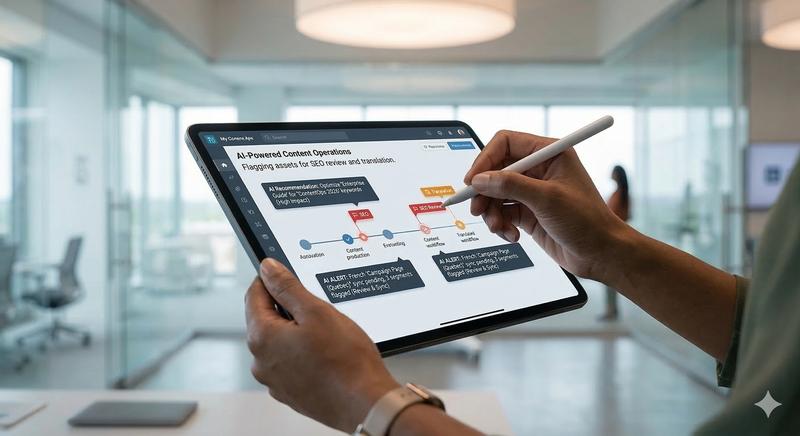
Workflow automation: AI can route content for approval based on topic, flag content that's missing required elements before it enters review, or suggest which existing content should be updated based on performance trends.
AI fails at strategic thinking, maintaining authentic brand voice, crafting complex B2B messaging, and original thought leadership. Those remain human responsibilities.
The key insight: AI is a tool within ContentOps, not a replacement for it. Organizations with strong content operations frameworks can use AI to accelerate specific tasks. Organizations without those frameworks just create chaos faster.
Headless CMS as ContentOps Foundation
Why Traditional CMS Blocks Content Operations
Traditional monolithic CMS platforms were designed for a single channel (typically a website) with tightly coupled content and presentation. That architecture creates systematic operational problems:
Content locked to presentation: You can't reuse content across channels without manually copy-pasting and reformatting. Creating the same content for your website, mobile app, and email campaign means creating it three times: triple the work and guaranteed inconsistency.
Developer dependency: Changing page templates, creating new content types, or adjusting the content model requires developer work. Marketing teams can't move faster than developer capacity allows.
Channel silos: Website content lives in the CMS, email content lives in the marketing automation platform, mobile app content lives in a separate system. There's no single source of truth, no systematic way to keep everything in sync.
According to Gartner's research, organizations spend 85% of their digital experience platform (DXP) effort and cost on integrations: stitching together systems that weren't designed to work together. That integration tax is the operational cost of traditional CMS architectures.
How Headless CMS Enables ContentOps
Headless CMS platforms decouple content from presentation. Content is stored as structured data and delivered via API to whatever frontend needs it. This architectural shift has several operational advantages:
Omnichannel by design: Content created once can be delivered to website, mobile app, email, social platforms, IoT devices, or AI-powered answer engines, all consuming the same content via API. Industry data shows that 82% of organizations report headless CMS simplifies their multi-channel delivery processes. There's no duplication, no manual reformatting, no keeping multiple versions in sync.
Content as structured data: Instead of "blog post" being a blob of HTML, it's a structured object: title, author, publication date, body text, featured image, category tags, related content links. This structure enables reusability, dynamic content assembly, and better analytics.
Reduced developer dependency: Marketing teams can create and publish content through the CMS interface without requiring developers for routine tasks. Benchmarks suggest headless CMS implementations can reduce time-to-market by 30-50% by eliminating publication bottlenecks.
Integration-ready architecture: API-first design means the CMS connects easily to your full martech stack: DAM, marketing automation, analytics, CRM. Data flows between systems without custom integration work.
The complexity objection is real. A January 2026 Reddit discussion noted: "Webflow is #2 CMS after WordPress specifically because headless CMS is too complex for marketing teams." This is a fair criticism. Headless platforms often prioritize developer experience over editor experience.
The solution isn't avoiding headless architecture. It's ensuring your implementation focuses on usability. At Dotfusion, we've implemented enterprise headless solutions on Agility CMS, Contentful, and Storyblok for organizations like Oxford Properties and Brookfield. The difference between successful and failed headless implementations isn't the platform. It's whether the implementation team bridges the gap between technical capability and marketing team usability.
Platform selection matters. Training matters. Custom editorial interfaces that hide technical complexity matter. Full-service implementation ensures marketing teams can actually use the platform, not just that developers approve of the architecture.
Case Study: Content Operations Transformation
A large Canadian commercial real estate company with 50+ properties across the country faced content operations challenges common to many enterprises. Their marketing team of 12 managed bilingual content (English and French) across multiple property websites, all running on an aging Drupal installation.
The problems were systemic: There was a consistent six-week lag from "content is ready" to "content is published" because basic content updates required developer tickets. Bilingual publishing meant manual duplication: create the English version, export to Word, send to translator, manually re-create the French version, and hope they stayed in sync (they rarely did). The developers became a permanent bottleneck because the CMS required technical expertise for routine tasks. There was no visibility into what content was in progress, who was working on what, or why things were delayed.
The waste was measurable. Applying Aprimo's $2.5 million annual cost estimate to their operational dysfunction was conservative. They were paying for duplicated effort, missed campaign windows, and content that took so long to publish it was outdated by launch.
The transformation combined technology and process. The team migrated to a headless CMS with several key operational improvements:
Bilingual content models ensured English and French versions were linked in the system rather than manually duplicated. When English content updated, the French version automatically flagged for translation review. Content creators worked in a single system rather than coordinating between the CMS, Word documents, and email threads.
Automated property data feeds pulled information from existing systems, eliminating manual data entry and ensuring accuracy. Marketing team members received training and custom editorial interfaces designed for their workflows, not generic admin panels designed for developers.
Workflow automation meant content moved from draft to review to approval to publication without manual coordination overhead. Everyone had visibility into status, bottlenecks were obvious, and accountability was clear.
The results were dramatic. Time-to-publish dropped 40%, eliminating most of the six-week lag. Similar case studies from European enterprises like Viridor documented £80,000 in annual license cost savings by consolidating tools. The marketing team gained autonomy. They could publish routine content updates without developer involvement, freeing developers for complex technical work. Bilingual content stayed synchronized because the system enforced the linkage. Engagement metrics improved 18% year-over-year, partly due to more timely, relevant content.
The environmental impact was an unexpected bonus: by reducing travel for content coordination and eliminating paper-based approval processes, the organization measured a 40% reduction in CO2 emissions related to content operations.
The transformation took eight months from initial planning to full rollout. Most of that time was spent on process design, training, and change management, not technology configuration. The lesson: ContentOps is primarily an operational challenge, not a technical one.
Building Your Content Operations Strategy
Step 1 - Audit Current State
Before designing your ideal ContentOps framework, document how content actually flows through your organization right now. Ask these diagnostic questions:
How long does it take from initial content brief to published content? Track several recent examples and calculate average cycle time. Enterprises are often shocked to discover it takes 4-6 weeks for routine content.
Where are the bottlenecks? Is content waiting for approval? Stuck in technical formatting? Delayed because nobody knows it's ready for the next stage? Map the process and identify where delays consistently occur.
How many tools are in your content stack? List every platform content touches from ideation through publication. Many enterprises discover they're juggling 15-20 tools with minimal integration between them.
Can you reuse content across channels? If you want to take a blog post and turn it into social content, email copy, and a sales enablement one-pager, how much manual work does that require? Most traditional systems make reuse harder than creating from scratch.
Can you measure content ROI? Do you know which content drives pipeline, influences deals, or converts visitors? If your analytics are disconnected from your content systems, you're flying blind.
These questions reveal your operational maturity. Most enterprises find significant gaps between their ambitious content strategies and their operational capacity to execute those strategies.
Step 2 - Define Success Metrics
Content operations needs measurable KPIs. Define both leading indicators (process health) and lagging indicators (business impact):
Content velocity measures time from brief to published. Target a 50% reduction from your current baseline. If it takes six weeks now, aim for three weeks within 90 days of implementing new processes.
Cost per asset is your total content team cost divided by the number of assets produced. This should trend downward as efficiency improves, though be careful not to optimize purely for volume at the expense of quality.
Content reuse rate tracks what percentage of content gets repurposed for other channels or campaigns. A target of 30% or higher indicates you're successfully treating content as reusable assets rather than single-use disposable material.
Team capacity utilization measures sustainable output: assets per team member per month. The goal isn't maximizing this number (that leads to burnout), but rather achieving consistent, predictable output.
Quality scores based on engagement metrics, conversion rates, and stakeholder feedback ensure that speed improvements don't come at the cost of effectiveness.
Time-to-market for campaigns measures how quickly you can go from campaign concept to fully launched content supporting it. According to industry benchmarks, organizations implementing proper ContentOps achieve 30-50% faster time-to-market.
Track these metrics monthly and review trends quarterly. The goal is continuous improvement, not hitting arbitrary targets.
Step 3 - Start with Process, Not Technology
The most common mistake is buying technology first and figuring out process later. That's backwards. Process design should drive technology selection, not the other way around.
Start by documenting current workflows, even if they're broken. Map every step content goes through from ideation to publication. Include every handoff, every approval, every tool switch, and every wait state. This documentation reveals where the operational problems actually are.
Then design your ideal state process. What would the workflow look like if everything worked smoothly? Who would own each stage? What information needs to be handed off between stages? What approvals are genuinely necessary versus ceremonial? How would you measure whether the process is working?
Only after defining your ideal process should you evaluate which technology can support it. The wrong sequence is "We need a headless CMS. Now let's figure out our process." The right sequence is "Our process requires omnichannel content delivery, workflow automation, and marketing team autonomy. Now let's evaluate which headless CMS platforms support those operational requirements."
As one industry observer noted: "Organizations becoming system integrators" is the fate of those who let technology dictate process. Don't make that mistake.
Step 4 - Choose the Right Technology Stack
Platform selection should be driven by your specific operational requirements, not by what's trendy. Key criteria for enterprise ContentOps:
Marketing team usability. Can non-technical content creators actually use this system, or will they need developer support for routine tasks? Evaluate from the content creator's perspective, not just the technical team's perspective.
Multi-language support. If you're a Canadian enterprise managing English and French content, or a global company managing a dozen languages, this capability needs to be native to the platform, not bolted on through plugins. For enterprises with specific Canadian requirements, our guide to headless CMS for Canadian enterprises covers compliance and bilingual considerations in depth.
API flexibility for integrations. Your CMS needs to connect to your marketing automation, analytics, DAM, CRM, and other systems in your martech stack. Evaluate integration complexity before committing. Remember that Gartner estimates 85% of DXP cost goes to integrations.
Workflow automation capabilities. Can the platform route content for approval, track status, send notifications, and enforce process steps? Or will you need separate project management tools?
Scalability for future growth. Can the platform handle 10x your current content volume if your business grows? Can it support additional channels as your strategy evolves?
At Dotfusion, we're platform-agnostic experts in Agility CMS, Contentful, and Storyblok. We help enterprises select the platform that actually fits their operational requirements, not the one with the best marketing or the lowest sticker price. The wrong platform is expensive regardless of license cost.
Step 5 - Implement Incrementally
Phase 1 (Months 1-3): Process documentation and pilot workflow. Pick one content type (blog posts, for example) and implement the full ContentOps process for just that content type. Document the workflow, assign role owners, implement tools, train the team, and measure results. Learn from this pilot before expanding.
Phase 2 (Months 4-6): Technology implementation and training. Migrate to your new headless CMS or implement workflow automation tools based on what you learned in the pilot. Expand the process to additional content types. Provide hands-on training, not just documentation dumps.
Phase 3 (Months 7-9): Full rollout and optimization. Expand ContentOps processes to all content types and all teams. Measure performance against the KPIs you defined. Identify remaining bottlenecks and address them. Capture lessons learned and update documentation.
Phase 4 (Ongoing): Continuous improvement. Content operations isn't a project with an end date. It's an operating discipline. Review metrics monthly, gather team feedback, and continuously optimize.
Most enterprises see measurable improvements within the first 90 days. Full maturity takes 6-9 months. The incremental approach prevents the "boil the ocean" problem that kills most transformation initiatives.
Content Operations and Answer Engine Optimization (AEO)
The Evolution of Content Discovery
For two decades, search engine optimization (SEO) focused on Google. Content needed to rank in traditional search results, the ten blue links. That model is evolving rapidly.
Answer engines like ChatGPT, Perplexity, Claude, and Gemini increasingly answer user queries directly without sending users to websites. When someone asks "what is content operations?", these AI systems synthesize an answer from multiple sources rather than just linking to top-ranking pages.
Gartner warns that by 2027, 40% of organizations will fail to deliver customer experience objectives due to lack of AI-driven content coordination. This isn't speculation. It's the logical consequence of content discovery shifting from traditional search engines to AI answer engines.
Content operations and answer engine optimization are interconnected. AEO requires well-structured, accurate, properly-cited content, exactly what good ContentOps produces.
How to Optimize ContentOps for AEO
Five ContentOps practices that improve answer engine visibility:
Structured content models. Answer engines parse structured data more effectively than unstructured HTML blobs. Headless CMS platforms store content as structured data by design: title, author, body, metadata, relationships to other content. This machine-readable structure helps AI systems understand and reference your content accurately.
Rich metadata and context. Answer engines rely on context to determine relevance and credibility. Your ContentOps process should systematically enrich content with descriptive metadata, author credentials, publication dates, topic categories, and relationships to other content pieces.
Entity-based optimization. Answer engines work with entities (people, companies, products, concepts) and relationships between them. Content operations should ensure consistent entity references throughout your content library and clear relationship definitions.
FAQ schema and direct answers. Structure content to answer specific questions directly. FAQ sections, clear definitions, step-by-step processes, and direct answers to common queries all improve answer engine visibility.
Content accuracy and citations. AI systems increasingly prioritize credible, well-cited sources. Your ContentOps process should require proper attribution for statistics, data points, and claims. This improves both credibility and discoverability.
For enterprises optimizing content for both traditional search and answer engines, our work in answer engine optimization for commercial real estate demonstrates how industry-specific content can be structured for maximum AI visibility.
The key insight: AEO doesn't require fundamentally different content. It requires better-structured, better-documented, more-accurate content, which is exactly what mature content operations delivers.
Canadian vs. US Content Operations Considerations

Unique Canadian Enterprise Requirements
Canadian enterprises face operational requirements that US-focused ContentOps frameworks often miss:
Data residency and compliance. PIPEDA (Personal Information Protection and Electronic Documents Act) and provincial privacy laws like Quebec's Law 25 create specific requirements for where content is stored, how user data is collected, and what consents are required. Your ContentOps technology stack needs to support Canadian data residency or include proper data processing agreements with vendors.
Bilingual content requirements. Federal bilingualism and Quebec's language laws aren't optional for many enterprises. Content operations must systematically handle English and French content creation, translation workflows, and synchronized publishing. Manual duplication doesn't scale. You need bilingual content models built into your CMS.
The Canadian market is smaller but often higher-value. Search volume for "headless CMS" is 720 per month in Canada versus 4,400 in the US, about 6x smaller. But Canadian enterprises often prefer working with vendors who understand Canadian requirements rather than adapting US-focused solutions.
Bilingual Content Operations
As one frustrated CMS user noted: "Multi-lingual support issue in Keystone is still open since 2018. It's the end of 2025, and people are still creating CMSs without multilingual support by design." Many platforms treat multilingual as an afterthought, forcing manual workarounds that break operational efficiency.
Best practices for bilingual ContentOps:
Content models designed for translation workflows. English and French versions should be linked at the data model level, not managed as separate pieces of content. When English content updates, the system should automatically flag the French version for translation review.
Avoid manual duplication. Every manual step is an opportunity for error and drift. Translation should happen within the workflow, not through Word document exports and re-entry.
Use headless CMS with native bilingual support. Platforms like Agility CMS (Canadian company) and Contentful have robust native multilingual capabilities. Platforms where multilingual is plugin-based tend to be more fragile.
Human translators with AI assistance. AI can provide first-pass translations, but human translators ensure cultural appropriateness, brand voice consistency, and technical accuracy. ContentOps defines the systematic handoff between AI assistance and human refinement.
For Canadian enterprises evaluating platforms, our guide to headless CMS for Canadian enterprises provides detailed platform comparisons with Canadian-specific evaluation criteria.
Avoiding "Composable Regret" in Content Operations
The Integration Complexity Trap
Composable architecture (assembling best-of-breed tools through API integration rather than using monolithic platforms) promises flexibility, reduced vendor lock-in, and optimized capability in each category. The reality is more complicated.
One industry observer noted: "Within the MACH community, debate about whether dogmatically applying MACH architecture was simply recasting rigid software suites in a new mould." Another stated bluntly: "Enterprises have become de facto system integrators, stitching APIs together, debugging data flows, and juggling multiple vendor relationships."
Gartner's research that 85% of digital experience platform (DXP) effort and cost goes to integrations isn't theoretical. It's the lived experience of enterprises that embraced composability without considering operational complexity.
The symptoms of "composable regret" are predictable: complex debugging across multiple vendors when something breaks, integration maintenance consuming developer time, tool sprawl (17 disconnected tools on average according to Eptura), and capability sitting unused because integration complexity makes it inaccessible.
How to Build Composable ContentOps Without Regret
Composable architecture isn't wrong. Premature complexity is. Guidelines for successful composable ContentOps:
Start simple. Don't compose 17 tools on day one. Start with a core stack: headless CMS, marketing automation, analytics. Prove the value of that foundation before adding complexity.
Integration-first thinking. Before buying a new tool, evaluate integration complexity. Does it have pre-built connectors to your existing stack? Is the API well-documented? What's the ongoing maintenance burden? The tool with the best standalone features isn't the best choice if integration is painful.
Choose proven partnerships. Platform vendors increasingly offer certified integration partnerships. A Contentful-HubSpot integration that's been tested by thousands of organizations is less risky than a custom integration between obscure tools.
Guided implementation. Expert implementation prevents costly mistakes. At Dotfusion, we design composable architectures that prevent composable regret. Our approach: right-size the initial stack, ensure integrations are robust before adding complexity, and design for maintainability from day one.
The goal of composable architecture is operational flexibility, not technical complexity for its own sake. If composability creates more operational overhead than the flexibility is worth, you've implemented it wrong.
Measuring Content Operations ROI
The $2.5M Business Case
Calculating ContentOps ROI starts with quantifying current inefficiency. Aprimo's $2.5 million figure is an average. Your specific cost depends on content volume, team size, and current operational maturity.
Framework for measuring cost reduction:
Time savings from eliminating coordination overhead, reducing approval cycle times, and automating manual handoffs. If your team of 12 spends 30% of their time on coordination rather than creation, and you reduce that to 15%, you've freed up 1.8 FTE worth of productive time, about $180,000 annually at typical enterprise salaries.
Reduced duplication from content reuse and better asset management. If you currently recreate content for different channels because finding and adapting existing content is too hard, quantify how many assets could be reused instead. At 30-60 minutes per asset and hundreds of assets per year, savings accumulate quickly.
Reduced rework from quality processes that catch issues early. When content reaches final approval and gets rejected because it doesn't meet requirements, you've paid for creation twice. Systematic quality gates throughout the process prevent expensive rework.
Beyond cost reduction, ContentOps drives revenue impact:
Faster time-to-market creates competitive advantage. Industry benchmarks suggest 30-50% faster content publication with proper ContentOps. That means your campaign launches before competitors', your product launches have supporting content ready, and you capture seasonal opportunities other organizations miss.
Better conversion from higher-quality, more relevant content. When content is strategically aligned, on-brand, and properly optimized, conversion rates improve. Even small percentage improvements in conversion translate to significant pipeline impact.
Increased content volume at sustainable pace. With operational efficiency, the same team can produce more content without burning out. More content (when strategically aligned) means more touchpoints, more discoverability, more pipeline.
A realistic ROI calculation for a mid-size enterprise:
Annual content production: 500 blog posts, 200 landing pages, 1,000 social posts, 50 case studies
Time savings: 30% reduction in production time through ContentOps = 600 hours saved
Value of time saved: 600 hours × $100/hour = $60,000 annual savings
Quality improvement: 10% increase in conversion rate on $1M pipeline = $100,000 additional revenue
Implementation cost: $50,000 (consulting, technology, training)
First-year ROI: $160,000 gain - $50,000 cost = $110,000 net benefit = 2.2x ROI
Most enterprises see payback within 6-12 months. Three-year ROI typically exceeds 5x when accounting for compounding efficiency gains.
KPIs That Matter
Track both leading and lagging indicators:
Leading indicators (process health):
- Time-to-publish trending down
- Approval cycle time trending down
- Content reuse rate trending up
- Team capacity utilization stable (not spiking, which indicates unsustainable pace)
Lagging indicators (business impact):
- Content-attributed revenue trending up
- Organic traffic growth
- Engagement metrics (time on page, pages per session) improving
- Marketing-qualified leads (MQLs) from content increasing
- Customer acquisition cost (CAC) decreasing
Review leading indicators monthly to catch process degradation early. Review lagging indicators quarterly to measure business impact.
The key is connecting process improvements to business outcomes. ContentOps justification isn't "we publish faster." It's "we publish faster, which means we capture more seasonal opportunities, which increased Q4 pipeline by 15%."
Frequently Asked Questions
What is the difference between content operations and content management?
Content management focuses on storage and publishing. Your CMS is a content management tool. Content operations is the broader discipline covering people, processes, and technology across the entire content lifecycle from ideation through measurement and reuse. Content management is a component of content operations, not a synonym for it.
Do we need a dedicated Content Operations Manager?
For enterprises producing significant content volume (100+ assets per month), yes. The role pays for itself by eliminating inefficiencies worth an average of $2.5 million annually according to Aprimo's research. Smaller organizations can assign ContentOps responsibilities to an existing role, but large enterprises need dedicated ownership.
Can we implement content operations with our existing CMS?
Partially. You can improve processes with any CMS by documenting workflows, defining roles, and coordinating more systematically. However, headless CMS architectures enable more advanced ContentOps capabilities like omnichannel delivery, workflow automation, and seamless integrations. Many enterprises find their legacy CMS becomes the bottleneck preventing operational improvement.
How long does content operations transformation take?
Expect 6-9 months for full implementation from initial audit through mature operational state. However, you can see measurable results from process improvements in the first 90 days with a focused pilot. The phased approach (pilot → expand → optimize) reduces risk and enables learning along the way.
What's the biggest mistake enterprises make with content operations?
Buying technology first and figuring out process later. The right sequence is: document current process, design ideal process, then select technology to enable that process. Organizations that start with "we need a headless CMS" before understanding their operational requirements often implement platforms their teams can't effectively use.
Is content operations relevant for B2B companies?
Especially for B2B. Enterprise sales cycles require consistent, high-quality content across multiple touchpoints: awareness content, educational content, comparison content, proof content, enablement content. ContentOps ensures your sales team can find the right content at the right time, that content stays current and on-brand, and that you can measure which content influences pipeline.
How do we balance content velocity with content quality?
This tension is exactly what ContentOps addresses. The framework uses process discipline (templates, workflows, systematic reviews) combined with enabling technology (headless CMS, workflow automation) to deliver both speed and quality. Without ContentOps, you're forced to choose. With mature ContentOps, you achieve both.
What role does AI play in content operations?
AI is a tool within ContentOps, not a replacement for it. Use AI for repetitive tasks like generating content briefs, suggesting optimizations, repurposing content for different channels, and routing workflows. Keep humans responsible for strategy, brand voice, complex messaging, and quality judgment. The productivity paradox (77% of employees using AI say it added to their workload, according to Upwork) happens when organizations add AI without proper ContentOps discipline to coordinate its use.
Conclusion
Content operations is the systematic coordination of people, process, and technology across the content lifecycle. It's not a technology purchase or a reorganization. It's an operational discipline that makes everything else work.
The business case is clear: enterprises waste an average of $2.5 million annually on inefficient content processes according to Aprimo. Symptoms include coordination overhead that consumes more time than actual creation, content bottlenecks that slow time-to-market, inconsistent quality, and inability to measure what's working.
The framework has three pillars, in order of importance: people (defined roles with clear ownership), process (documented workflows with automated handoffs), and technology (headless CMS and integrated martech stack). Most enterprises get the sequence backwards, buying technology first and wondering why adoption fails.
AI accelerates content generation but doesn't solve coordination challenges. Without ContentOps discipline, AI just helps you create chaos faster. The data is stark: 68% report increased ROI from AI according to SEMrush, but 77% of employees using AI say it added to their workload, according to the Upwork Research Institute. The difference is whether you have operational frameworks to harness AI effectively.
The complexity objection to headless CMS is valid: these platforms can be too technical for marketing teams. The solution isn't avoiding headless architecture. It's ensuring implementation focuses on usability, not just technical capability. Technology enables content operations; it doesn't replace it.
For Canadian enterprises, bilingual requirements and compliance considerations make content operations even more critical. Manual bilingual content duplication doesn't scale, and data residency requirements affect platform selection.
The composable architecture trend promises flexibility but creates integration complexity. Organizations embracing composability without operational discipline become system integrators rather than content producers. Start simple, prove value, add complexity incrementally.
Content operations isn't optional in 2026. It's competitive advantage. Eighty percent of enterprises are adopting headless or composable architectures. Those who combine that technology with operational discipline will win. Those who don't will just spend more money producing the same chaos.
If your organization struggles with content bottlenecks, coordination overhead, or inability to scale content production sustainably, you need content operations. Not more tools. Not more headcount. Operational discipline that makes your existing resources dramatically more effective.
Ready to build a content operations framework for your enterprise? Dotfusion has implemented ContentOps solutions for Canadian organizations like Oxford Properties and Brookfield, combining headless CMS platforms with systematic operational frameworks. Book a free 30-minute content operations audit to identify your biggest bottlenecks and get a practical roadmap for improvement.
This post was conceived and written by Chris Bryce with our stack of AI research agents doing the heavy lifting on sources and data. If you want to talk about enterprise web strategy, AEO, or content operations, talk to us. We love this stuff.