— Commercial Real Estate
Investors, Tenants, Shoppers: The Multi-Audience Website Problem Every Enterprise CRE Company Has
Enterprise commercial real estate companies serve three fundamentally different audiences from one website: institutional investors, corporate tenants, and on-site visitors. Most content platforms weren't designed for that level of governance complexity. Here's how Oxford Properties and First Canadian Place solved it with headless CMS architecture.
Every enterprise CRE company has the same website problem. The platform was built when one team published one type of content for one primary audience. Then the business grew.
Now there are institutional investors who need portfolio data, ESG reports, and capital deployment information. There are corporate tenants who need floor plate specs, availability, and a direct path to a leasing contact. And there are the shoppers, visitors, and event attendees who just need to know where to park and what's on this week.
Three audiences. Three content types. Three publishing cadences. Three governance models. One platform that wasn't designed for any of that complexity.
This is the multi-audience website problem. It's not unique to one company or one asset class. It shows up across office, retail, industrial, and mixed-use portfolios. And it's the specific challenge that headless CMS for commercial real estate was built to solve.
Why Commercial Real Estate Websites Need Headless CMS Architecture
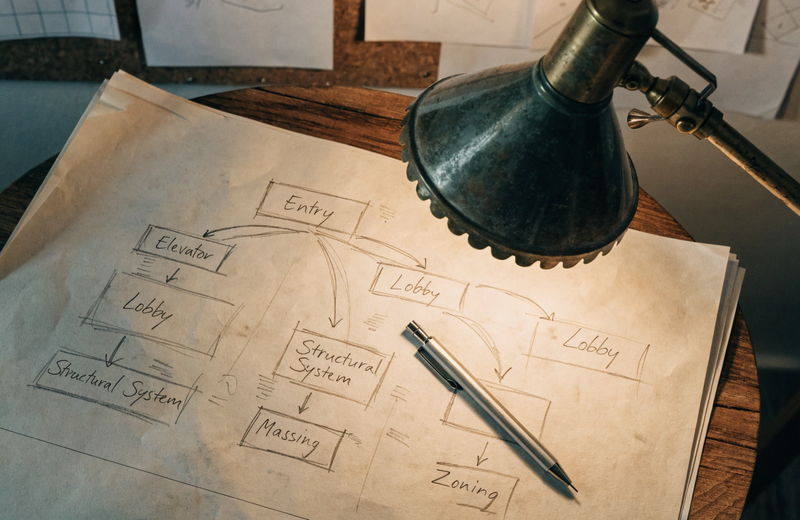
The multi-audience CRE website isn't a content problem. It's an architecture problem.
Most content management platforms were designed around one editorial model: one team, one publishing workflow, one set of content types. That worked well for centralized organizations with predictable content cadences.
CRE organizations don't work that way. The investor relations team operates on a quarterly reporting cycle with legal review on every update. The leasing team publishes in real time when space becomes available. The property management team updates events, parking notices, and tenant communications constantly.
These aren't three different perspectives on the same content. They're three separate publishing operations sharing one digital infrastructure. When the platform was built for one of them, the other two feel it immediately.
Developer queues back up. Governance breaks down. The marketing team ends up coordinating requests from internal stakeholders who all need something different, right now, without stepping on each other. That's not a team problem. It's an architecture problem.
The Three Audiences Every Enterprise CRE Company Serves
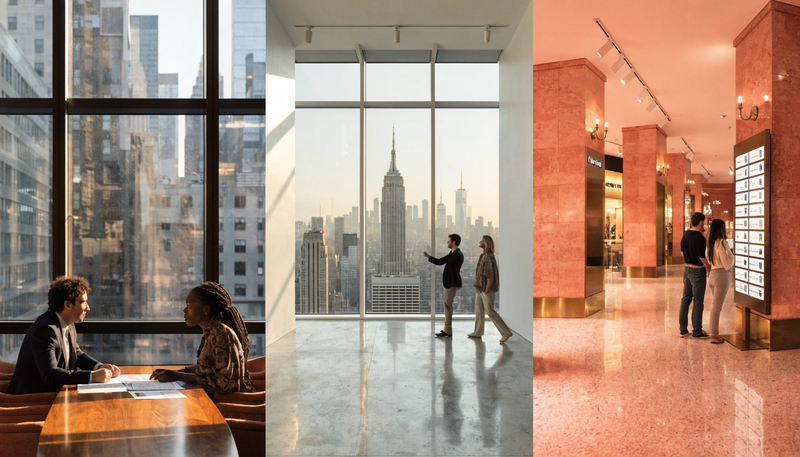
Understanding the fix starts with understanding who actually uses a commercial real estate website.
Institutional investors come looking for credibility and structured data. Portfolio overviews, investment performance, ESG commitments, IR contacts. The content is formal and compliance-adjacent. It changes on a predictable cycle and needs tight governance.
Corporate tenants are in evaluation mode. They need available space, floor plate dimensions, building specs, amenities, and a direct path to a leasing conversation. This content is operationally driven. When space becomes available or gets leased, the page needs to reflect that immediately. The leasing team owns it, not marketing.
On-site visitors and shoppers want something different: retail directories, event listings, hours, parking, wayfinding, food options. This content is high-velocity and property-specific. It changes daily and is managed by property staff, not a central digital team.
These three audiences don't just want different information. They want it organized differently, displayed differently, and updated by different people on different schedules. A platform built to serve one of them well will frustrate the other two.
Why This Breaks Most CRE Websites
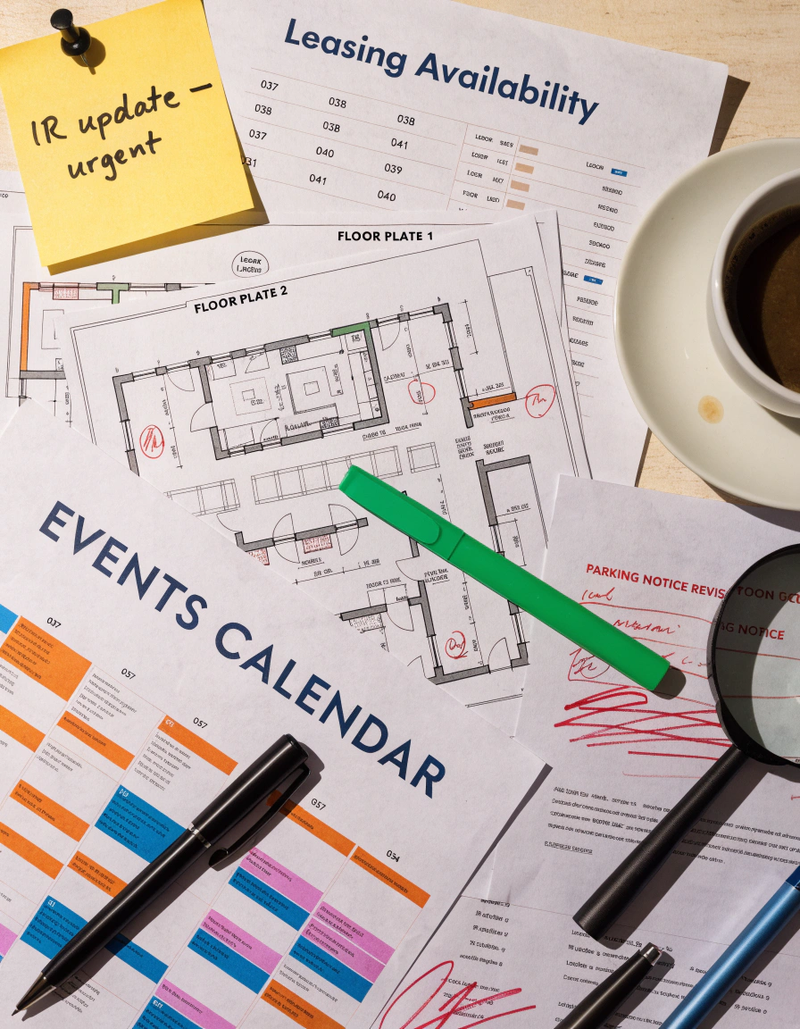
Traditional content platforms were built around a core assumption: content and presentation live together. One team controls the CMS. That team pushes content to one primary audience.
That model worked well for a long time. It still works for many organizations. But it wasn't designed for the governance complexity that a multi-property, multi-audience CRE company actually operates.
When a leasing team needs to update availability across 40 properties, they shouldn't need a developer. When an events coordinator adds weekend programming, it shouldn't touch the IR section. When investor relations updates portfolio data, they shouldn't be waiting in a queue behind a parking notice.
The issue isn't that older platforms failed. They were built for a simpler publishing model. The CRE industry has outgrown it.
How Oxford Properties Solved It
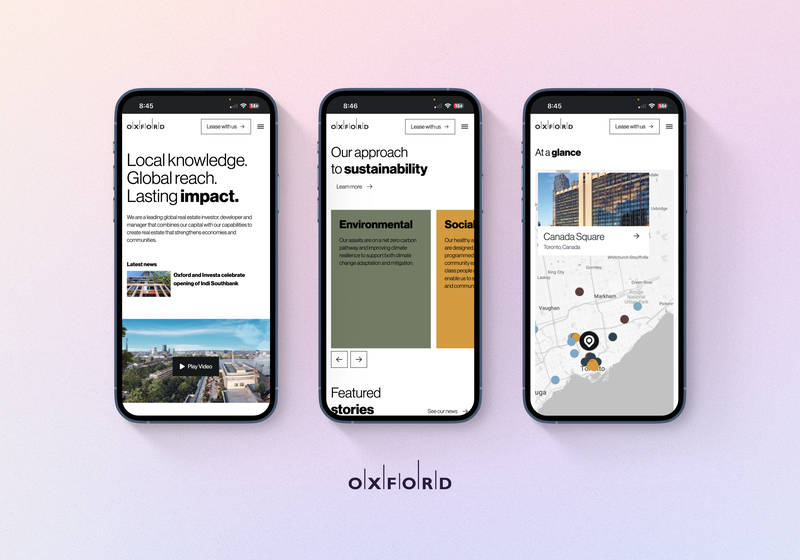
Oxford Properties is a global leader in real estate investment, development, and management, with assets spanning offices, industrial, life sciences, and retail across North America and Europe.
Their platform had to serve all of it. Thousands of property pages. Multiple asset classes. Audiences ranging from institutional investors evaluating Oxford's portfolio to corporate tenants sourcing space to visitors at individual properties.
Dotfusion built Oxford's platform on Agility CMS using a headless architecture that separates content storage from content delivery. Each team manages its own content domain without touching what belongs to another.
A few things that make this work at global scale:
- Dynamic templates connected to Oxford's leasing API. Property availability pages update automatically when leasing data changes. No manual publishing step, no developer involvement.
- Bynder DAM integration. A unified global asset library gives every team access to approved brand assets without routing requests through a central creative team. Consistency across thousands of pages without the bottleneck.
- Elastic Search on the front end. Tenants searching for available space get fast, relevant results across a large portfolio.
- Navigation redesigned around audience segments. The site's information architecture separates Oxford's investment, development, and management sections cleanly, so each audience finds what they need without wading through content meant for someone else.
The platform also supported a full content migration of hundreds of existing property pages, preserving structure in the move to the new architecture.
How First Canadian Place Solved It
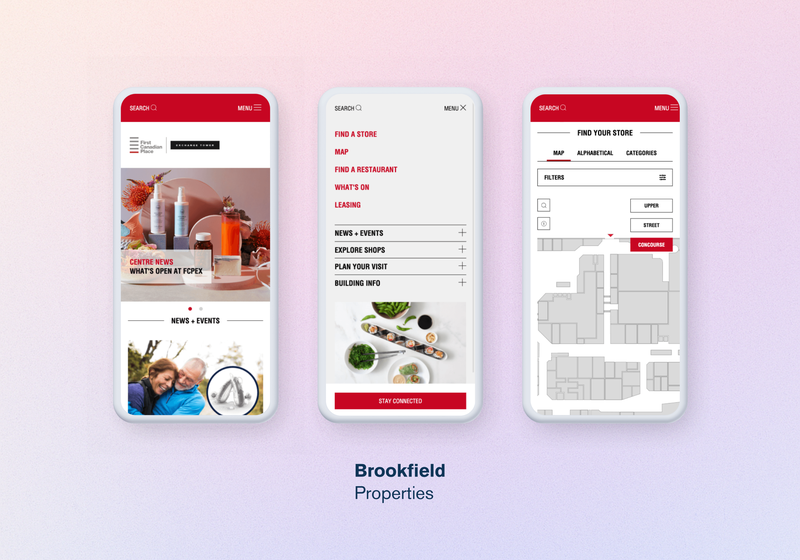
First Canadian Place is a different project entirely. Where Oxford Properties is a global portfolio company, FCP is a single 72-storey mixed-use tower in downtown Toronto, operated by Brookfield Properties.
The multi-audience problem here is concentrated in one building. It's just as complex.
Dotfusion built FCP's platform on React and Agility CMS, with five distinct user paths built into the site's navigation. People come to First Canadian Place for entirely different reasons: Bay Street office tenants searching for space, retail concourse shoppers, attendees of the building's art and cultural events, business professionals heading to the marketplace, and visitors who need parking and wayfinding.
Each audience gets a clear, purpose-built path through the site, without navigating through content meant for someone else.
The integrations handle the operational complexity:
- Interactive wayfinding with MappedIn, so visitors can navigate the building on their own
- Salesforce Marketing Cloud for subscriber journey orchestration, delivering the right content to each audience segment at the right time
- Merchant listings with individual content control, letting retailers manage their own pages without going through a central team
- Kiosk and display integrations, extending the digital experience into the physical building
The result is a platform that's straightforward for visitors to use and equally manageable for the FCP team on the back end. Property-level staff can update what they own without touching anything that belongs to another team.
What Headless Architecture Actually Enables
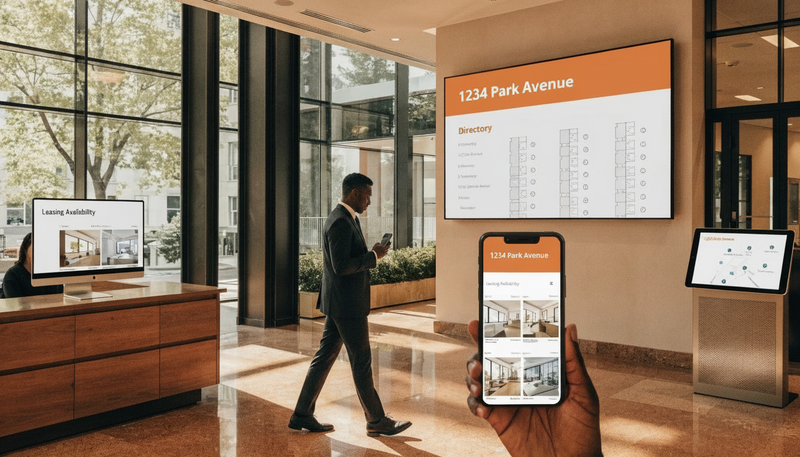
Both projects solve the same underlying problem with the same architectural approach.
In a headless CMS, content is stored as structured data, separate from how it's displayed. The presentation layer draws from that content through an API. One piece of content can power a website, a mobile app, a kiosk display, and a tenant portal without being republished four times.
For CRE organizations, this creates a few things that single-model platforms can't deliver cleanly:
Audience-specific governance. Each team manages its own content domain. The leasing team updates space availability. The IR team updates portfolio pages. The events team manages the calendar. None of these teams are blocked by each other, and none of them need a developer to do their job.
Real-time publishing at the property level. When a leasing API triggers a change, it publishes. When a property manager updates parking hours, it goes live. There's no approval queue between operational reality and what's on the website.
Integration with the broader tech stack. Because the platform is API-first, it connects to existing tools: a leasing API, a DAM, a marketing automation platform, a wayfinding system. Each integration handles a specific job. None of them require rebuilding what's already there.
This is what headless CMS architecture built for commercial real estate looks like in practice. It matches the platform to the actual publishing complexity of the organization. It doesn't ask teams to simplify how they work to fit the tool.
Frequently Asked Questions
What is the best CMS for a commercial real estate company managing multiple properties?
For enterprise CRE organizations managing multiple asset classes and audience types, an API-first headless CMS is the most practical architecture. Platforms like Agility CMS allow content teams to manage a single structured content repository while delivering purpose-built experiences to different audiences: investors, tenants, and visitors. The critical requirement is an API-first architecture that integrates with leasing systems, DAM platforms, and the marketing tools already in use. One platform, governed by multiple teams, delivering to multiple audiences.
How do REITs manage websites that serve both investors and tenants?
The most effective approach separates content governance by audience type at the architecture level, not just the navigation level. In a headless CMS implementation, the IR team, the leasing team, and the property marketing team each manage their own content domains within the same platform. The front-end experience for each audience is built from that shared repository. Governance stays clean. Publishing stays fast. No team is waiting on another to do their job.
Can a headless CMS handle multiple audiences from a single platform?
Yes, and this is one of the primary use cases for headless architecture in enterprise environments. Because content is stored as structured data and delivered through an API, the same platform can power different front-end experiences for different audiences. Oxford Properties' platform serves investors, corporate tenants, and property-level visitors from one content infrastructure. First Canadian Place serves five distinct user paths from the same Agility CMS instance.
What is composable architecture in commercial real estate?
Composable architecture means building a digital platform by connecting purpose-built third-party services through APIs, rather than relying on one monolithic system to do everything. For CRE organizations, this commonly includes a headless CMS as the content hub, integrated with a DAM for asset management, a leasing API for real-time property data, a CRM or marketing automation platform for tenant and visitor communications, and wayfinding or eCommerce tools where needed. First Canadian Place's platform: Agility CMS, Salesforce Marketing Cloud, MappedIn, and merchant listing tools working together, is composable architecture in practice.
How does headless CMS improve content governance for enterprise CRE?
Governance improves because each team manages only their own content domain. Roles and permissions are set at the content type level, not the page level. This means publishing can scale across large organizations without editorial conflicts or brand inconsistency. When dynamic templates connect to operational systems like leasing APIs, the platform updates automatically rather than depending on someone to remember to republish. Fewer manual steps means fewer errors, faster time to live, and fewer developers pulled into content updates.
Ready to Solve the Multi-Audience Problem?
If your CRE website is serving three different audiences from a platform built for one of them, the architecture is the issue.
Dotfusion builds headless CMS for commercial real estate organizations across North America: global portfolios, mixed-use landmarks, and multi-property enterprises of every scale. AEO is built into every platform from day one, so the site doesn't just work for the teams managing it. It gets found by the investors, tenants, and visitors searching for it. See why most CRE companies are invisible to AI answer engines and what to do about it.
When you're ready to talk about what the right architecture looks like for your portfolio, get in touch with Dotfusion.